At a glance
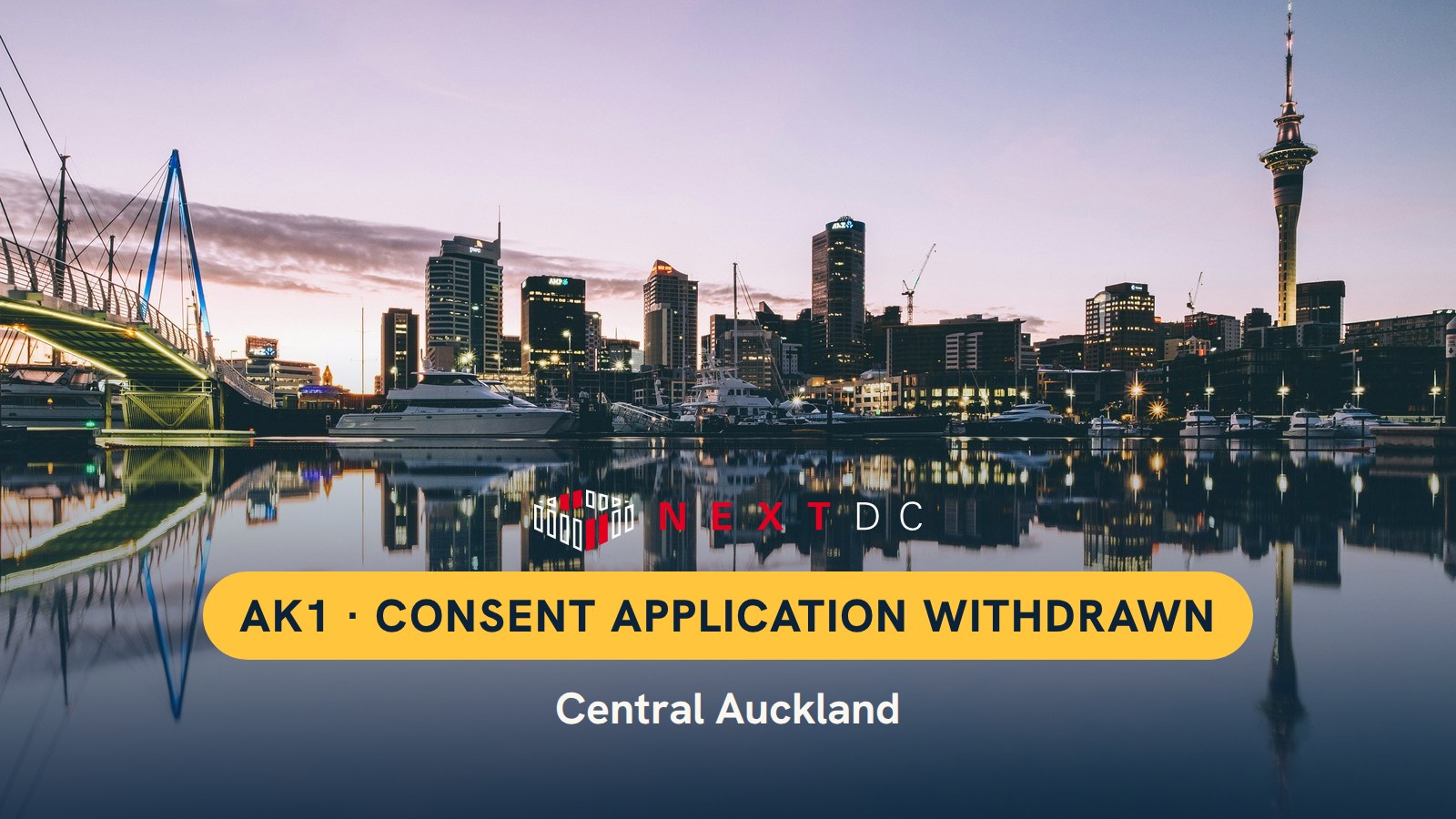
NEXTDC has withdrawn its resource consent application for a 15MW data centre between Nelson and Hobson Streets in central Auckland, BusinessDesk reported on 21 October 2026.
The ASX-listed operator lodged the application with Auckland Council on 17 July 2026 for a five-storey building on the whole block.
NEXTDC's FY26 results presentation in August listed the Auckland site, AK1, at about 15MW planned with an initial 1.7MW, and its status as under review.
NEXTDC described Auckland as a critical node in the Pacific subsea cable network when it applied for consent.
Separately, on 21 October NEXTDC cut its FY27 guidance after a power delay at its M3 data centre in Melbourne.
NEXTDC has withdrawn its resource consent application for a 15MW data centre in central Auckland, BusinessDesk reported on 21 October 2026. Auckland Council confirmed the withdrawal to the outlet, which described the project as the Australian operator's first New Zealand development.
NEXTDC lodged the application on 17 July 2026. It covered a five-storey building on the whole block between Nelson and Hobson Streets, with residential apartments to the north. In September the council told BusinessDesk the application was on hold pending further information from the applicant.
NEXTDC planned AK1 near Auckland's subsea cable landings, with about 15MW of power and an initial 1.7MW.
NEXTDC's August results listed AK1 as under review
NEXTDC's FY26 results presentation, released on 27 August 2026, listed AK1 Auckland with about 15MW of total planned power and an initial capacity of about 1.7MW. The project page in the same presentation gave its status as under review, while the highlights page recorded the resource consent application as lodged.
The NZ Herald reported in May 2023 that NEXTDC planned to spend A$140 million, about NZ$148 million at the time, on the project. That was three years before the consent application was lodged.
The assessment of environmental effects, prepared by McKenzie Lilley Planning, put the data halls on levels one and two. The plans put cooling towers, water pumps and gas turbines for emergency back-up power on the upper levels. Consent was needed because the application was for a non-complying activity in the business city centre zone, according to BusinessDesk's August report.
The assessment listed diesel, refrigerant gas and lithium and lead acid batteries as hazardous substances to be stored in the building. Operating noise would comply with the Auckland Unitary Plan standards, using acoustic enclosures for the turbine generators, rooftop noise barriers and quieter cooling tower plant, the assessment said. It concluded that any environmental effects were within acceptable limits.
NEXTDC chose the city centre for its cable links
NEXTDC set the project inside its Asia Pacific expansion. "Across these markets, NEXTDC continues to witness surging demand for sovereign, AI-ready, hyperscale digital infrastructure," the application said, as quoted by BusinessDesk in August. It called New Zealand "an important market in this region with a stable, high-growth digital economy".
NEXTDC described Auckland as a critical node in the Pacific subsea cable network. "Locating a NEXTDC data centre in proximity to these cable landings enhances route diversity, reduces latency, and strengthens the resilience of the region's digital infrastructure," the assessment said, as quoted by BusinessDesk.
The application described the city centre as "the most densely connected area for telecommunications and internet infrastructure".
A Melbourne power delay reset NEXTDC's spending
On 21 October NEXTDC cut its FY27 guidance after Jemena, the electricity distributor for its M3 data centre in Melbourne, suspended network works. It now expects net revenue of A$475 million to A$500 million, down from A$615 million to A$640 million.
NEXTDC has put "all new development projects and land acquisitions on hold for the foreseeable future", its ASX release said. Its board will report the outcome of a capital expenditure review by the annual general meeting on 20 November 2026, and will consider selling development sites that are not needed in the near term.
The Melbourne delay moves about A$140 million of FY27 net revenue, and the same amount of underlying EBITDA, out of NEXTDC's guidance while the M3 capacity stays under contract, subject to the customer's rights. Revised FY27 capital expenditure guidance of A$4.5 billion to A$5 billion covers contracted capacity due in the next 12 to 18 months and works close to completion. NEXTDC had A$8.7 billion of liquidity at 30 September 2026.
AK1 is one of three international projects NEXTDC highlighted
NEXTDC's FY26 highlights named three international projects at different stages. KL1 in Kuala Lumpur opened with a foundation customer, excavation and retaining works were in progress at TK1 in Tokyo, and AK1 Auckland had its resource consent application lodged. KL1 had 10MW delivered, 15MW in progress and 15MW more in plan at 30 June 2026, according to the presentation. TK1 construction works were under way. More on the operator is on the NEXTDC profile.
AK1's planned 15MW compares with about 208MW of colocation across 36 facilities in New Zealand, as our operator-by-operator guide counted in August, led by operators such as CDC. Our power list and build tracker follow the projects under way.
What to watch
NEXTDC's capital review. The board has committed to announcing the outcome of its capital expenditure review by its annual general meeting on 20 November 2026.
The Nelson and Hobson Streets site. A new consent application or a sale of the land will show where AK1 goes next.
NEXTDC's international build. At its FY26 result NEXTDC had 15MW in progress at KL1 and construction under way at TK1. The capital expenditure review due by 20 November covers its whole development program.