
At a glance
- Paul Newfield, chief executive of infrastructure investor Morrison, told the INFINZ conference in Auckland on 13 October 2026 that New Zealand should be winning AI work leaving the United States.
- He expects the US to run short of electricity and public support soon after its 3 November mid-term elections, pushing AI computing offshore.
- Morrison's assets include Infratil, which owns 49.69 per cent of CDC Data Centres, an operator in Auckland and a partner in a 250MW proposal at Stratford.
- BCG modelled 600MW for New Zealand over ten years, a target Newfield set against the single 555MW contract CDC signed in Australia in May with a US customer.
- CDC wants regulation that sets a floor, with data centres building new renewable generation rather than competing for existing supply, according to Newfield.
Paul Newfield, chief executive of Wellington infrastructure investor Morrison, told the Institute of Finance Professionals New Zealand conference in Auckland on 13 October 2026 that New Zealand "should be eating the US's lunch, and Australia will", interest.co.nz reported. Morrison has more than US$30 billion of assets under management, including through Infratil, which owns 49.69 per cent of CDC Data Centres.
Newfield put New Zealand's opportunity at hundreds of billions of dollars of GDP if it gets the conditions right, against the up to NZ$70 billion of economic activity BCG estimated in February. He measured BCG's 600MW case against one Australian contract of 550MW that Morrison's data centre business signed this year. That matches the 555MW, 30-year contract CDC signed in May 2026 with an unnamed US investment-grade customer.
Newfield expects the US to run short of power and public support
Newfield expects the US to "hit a constraint very soon, probably straight after the mid-terms", in electricity and in public support, which he called social licence. He named Democrat senator Bernie Sanders and Republican senator Josh Hawley, who he said agree on one thing: they hate data centres and AI.
That shortage would create "this massive overflow opportunity" for AI companies that need to build outside the US, he said. The country that wins it needs abundant, cheap renewable energy, data centres owned and regulated locally, membership of Five Eyes, regional stability, regulation set ahead of harm, and stable domestic politics.
In Newfield's view that list describes Australia, while New Zealand is "naturally way more advantaged" but has not made the case strongly enough or pushed fast enough. Anthropic expects Australia to be its largest AI development centre after the US, according to Newfield. Morrison's data centre business started getting inbound interest after missiles were fired at data centres in the UAE earlier this year, he said, from people who saw it as being in a safe part of the world.
US tax credits cover half the capital cost of building renewable generation, Newfield said, and New Zealand offers none.
BCG's February estimate was 600MW over ten years
Newfield recalled BCG's figure as 2 to 3 per cent of the Asia-Pacific AI data centre market, worth $60 billion, perhaps $70 billion, and 600MW. BCG's February 2026 study put up to NZ$70 billion of economic activity behind New Zealand's data centre build over the coming decade, with a modelled 600MW by 2035. Morrison's late founder Lloyd Morrison, he said, would have called that target pathetic.
BCG's August 2026 report put the potential at more than 1GW of new compute capacity over five years, up from the 600MW it modelled in February. It cited 11 data centre connections at assessment or design with Transpower that add up to a gigawatt. New Zealand has about 208MW of data centre capacity built across 36 facilities, on market researcher Arizton's June count.
CDC wants rules that set a floor
Newfield accepted that protests against data centres happen for "some really good reasons": fears that they will drive up power bills, use the water or shake the houses next door. None of that is necessary, he argued. "With our CDC business we are going out and saying we want regulation. We want regulation to set the floor, and we want to compete on how you meet it."
A data centre can be filled with water once and reuse it for 30 years at a higher cost, according to Newfield, and data centres should spur new renewable generation instead of competing for existing supply. CDC chief executive Greg Boorer backed strict national data centre standards in Australia on 1 October.
The Green Party's AI policy, published a day before Newfield spoke, asks new AI facilities to provide new renewable generation "rather than competing for existing electricity supply". The Greens pair that with a pause on consenting new hyperscale data centres.
Infratil values its CDC stake at A$9.2 billion
Infratil has made three announcements on CDC since August.
| Date | Announcement | What it says |
|---|---|---|
| 10 August 2026 | CDC and Contact Energy at Stratford | Two Infratil companies are exploring a data centre in Taranaki, later sized at 250MW |
| 16 September 2026 | FY27 guidance increase | CDC FY27 EBITDAF guidance raised to A$710 million to A$750 million; 350MW deployed and 1.1GW contracted |
| 6 October 2026 | CDC valuation at 30 September | Equity value A$17.4 billion to A$19.6 billion, mid point A$18.45 billion, down A$78 million on June |
Source: Infratil, NZX release, 16 September 2026, NZX release, 6 October 2026 and Infratil news, 10 August 2026.
Infratil attributed the A$78 million fall to "a material increase in the forward yield curve", which raised assumed interest costs and offset progress in contracting customers and building capacity. Its 49.69 per cent stake is valued at A$9,168 million.
In New Zealand, CDC runs three data centres on two Auckland campuses: Silverdale Campus One at 22MW, expected to grow beyond 60MW, and Hobsonville Campus One at 22MW and Campus Two at 54MW, on the company's own figures.
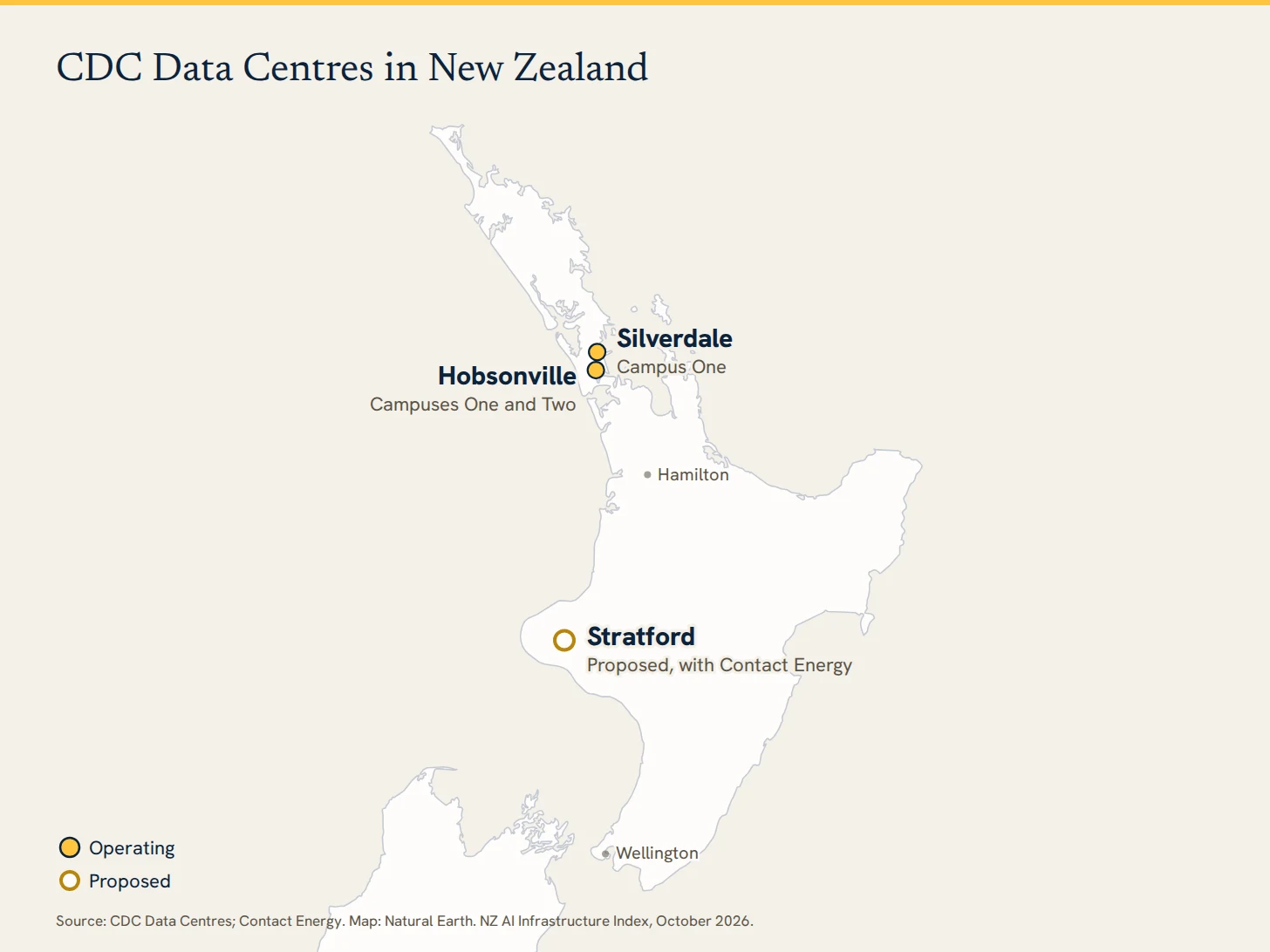
CDC's operating data centres at Silverdale and Hobsonville in Auckland, and the proposed Stratford campus with Contact Energy in Taranaki.
Contact Energy and CDC were preparing a consent application for the 250MW Stratford proposal in September, and Morrison entered exclusive talks with Orange on the French telco's data centres in August.
What to watch
- The US mid-term elections on 3 November. Newfield expects US power and public support to tighten soon after. A US data centre pause, or AI companies naming new overseas sites, would test it.
- New Zealand's election on 7 November. National, Labour and the Greens each ask data centres to bring new power, and the investment principles Economic Growth Minister Nicola Willis has held since 27 July carry no release date.
- The Stratford consent. Lodging it with Stratford District Council and Taranaki Regional Council would put a CDC project in New Zealand in front of consent authorities.
- A New Zealand contract at Australian scale. A single deal the size of CDC's 555MW contract would on its own reach most of BCG's February 600MW case.