
At a glance
BCG, the global consultancy, puts up to NZ$70 billion of economic activity behind New Zealand's data centre build over the coming decade.
The Auckland summit's working expectation was five to ten AI facilities of more than 100MW each by 2030, against about 208MW of installed capacity today.
Cushman & Wakefield prices New Zealand construction at US$7.3 million to US$11.2 million a megawatt, roughly NZ$12 million to NZ$19 million.
Epoch AI models a full gigawatt AI campus at about US$38 billion up front, roughly NZ$64 billion, about four times the buildings on their own.
Mercury holds 12.7 per cent of Datagrid and Contact would take up to half of Stratford, against development returns Brookfield's Sean Robertson put in the teens.
Auckland's summit put the pipeline at five to ten campuses
More than 250 executives, investors and engineers spent 12 August 2026 in a ballroom at Cordis Auckland working out how fast New Zealand can build, while about 30 protesters stood outside the hotel with water among their objections. By the close, the summit had broadly agreed on the shape of the next four years: five to ten AI facilities of more than 100MW each by 2030, sited close to generation. New Zealand runs about 208MW today, installed across 36 colocation facilities on the June count of the research firm Arizton.
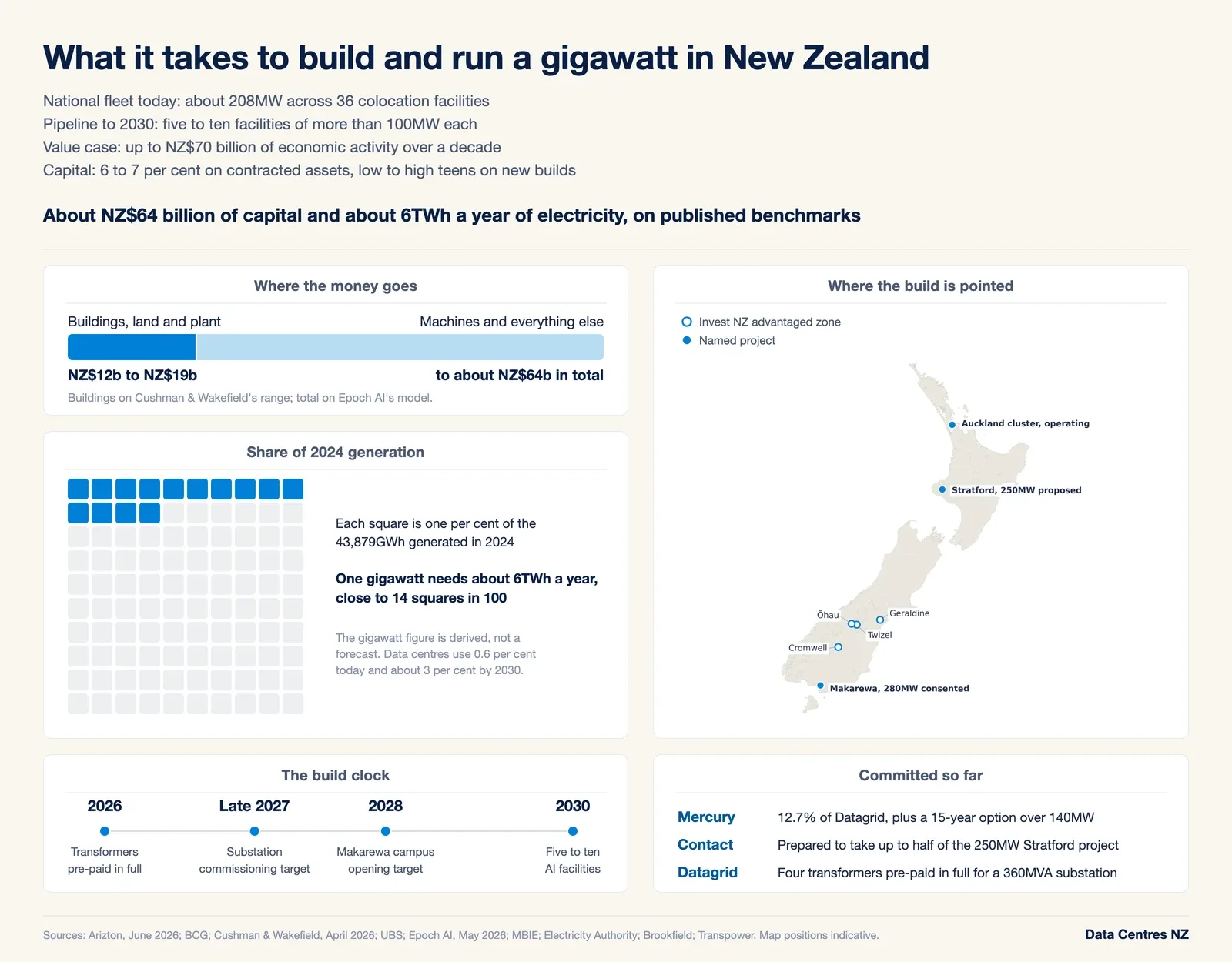
BCG, the global consultancy, has already sized the prize at up to NZ$70 billion of economic activity over the next decade, against a 600MW case it models to 2035, but nobody in the room put a comparable figure on what capturing it would cost. On published benchmarks, a gigawatt of AI capacity costs roughly NZ$12 billion to NZ$19 billion to house, about NZ$64 billion once the machines inside are counted, and needs about 6TWh a year to run. Those three figures are the working reference this publication will mark the market against, ahead of a full New Zealand report now in preparation.
Stratford gives New Zealand its clearest price per megawatt
UBS, the investment bank, puts the build cost of the proposed 250MW Stratford data centre in Taranaki at NZ$4.5 billion to NZ$5 billion, which works out at about NZ$18 million to NZ$20 million a megawatt. Cushman & Wakefield, the global property services firm, prices New Zealand data centre construction at US$7.3 million to US$11.2 million a megawatt in its April 2026 Asia Pacific guide, roughly NZ$12 million to NZ$19 million, and calls the market mid-pack in the region. Stratford therefore sits at the top of that range and a little above it, although the guide covers the facility itself and the computing hardware a tenant installs is extra, and UBS does not state what its own estimate includes.
The closing energy panel asked where the next 300MW of supply comes from, and on the published range that 300MW is about NZ$3.7 billion to NZ$5.7 billion of facility capital. Five to ten facilities of more than 100MW each imply at least NZ$6 billion, and NZ$19 billion or more at ten, before a server goes in. Invest New Zealand, the government's investment attraction agency, has named five advantaged data centre zones, Makarewa, Twizel, Ōhau, Geraldine and Cromwell, where it says grid capacity, energy infrastructure and backhaul fibre converge; its investment director Simon Ansley spoke on the summit's investment panel.
Servers cost about four times the buildings that house them
Those figures cover concrete, steel and plant, and Epoch AI, a research group that models the economics of AI infrastructure, prices the finished article a good deal higher: a one-gigawatt AI data centre of the kind a hyperscaler owns and operates costs about US$38 billion of up-front capital, roughly NZ$64 billion. That is about four times what the buildings alone cost on Cushman & Wakefield's range. On an annualised basis, which spreads the shorter life of the hardware against the longer life of the shell, Epoch puts servers at about 60 per cent of the cost. An operator at an industry investment forum quoted about A$50 billion to bring a gigawatt online in Australia, a figure examined in tokens per watt.
Cost component | Benchmark | Source |
|---|---|---|
Buildings, land and plant | US$7.3m to US$11.2m a MW, about NZ$12m to NZ$19m | Cushman & Wakefield, April 2026 |
Full AI data centre, servers included | About US$38 billion a GW up front, about NZ$64 billion | Epoch AI, May 2026 |
Electricity to run a gigawatt | About 6TWh a year | Derived from the Electricity Authority's Datagrid estimate |
Source: Cushman & Wakefield Asia Pacific Data Centre Construction Cost Guide 2026, Epoch AI, Electricity Authority. Converted at about NZ$1 to US$0.59.
The two layers land on different balance sheets: operators fund the buildings, and tenants install their own hardware under contracts such as the neocloud Sharon AI's US$1.32 billion five-year deal, the largest AI cloud contract disclosed in New Zealand.
Mercury and Contact buy into the projects they would power
Mercury has paid US$30 million for 12.7 per cent of Datagrid, the developer of a consented 280MW campus at Makarewa in Southland, and holds a 15-year option over 140MW of supply. Contact says it is prepared to take up to half of the Stratford project it is proposing with CDC, whose largest single shareholder is the NZX-listed infrastructure investor Infratil, and offshore money sits alongside them, with Brookfield owning DCI Data Centres and its 40MW AKL02 under construction in Auckland.
Sean Robertson, managing director for debt investments at Brookfield Asset Management, told the summit's investment panel that established data centres with contracted income return 6 to 7 per cent, and that new developments carry return expectations in the low to high teens. This week Transpower confirmed that Datagrid has pre-paid in full for four transformers for its 360MVA Southland substation, with commissioning targeted for late 2027. Trade sources price transformers of that class above US$10 million each, and Transpower chief executive James Kilty said procuring the long-lead items helps Datagrid meet its planned timeline. Datagrid founder and chief executive Rémi Galasso says the specialist technicians and engineers a build like this needs are in short supply, and they have to be secured against the same date.
Simeon Brown wants new generation behind the AI load
Energy Minister Simeon Brown set out the government's position the weekend before the summit. "At a principled level, I want AI data centres underwriting new generation and growing generation in New Zealand," he told 1News, adding that the facilities "are going to need firming as well" and that he does not want them "pushing up the power bills of ordinary Kiwis". Brown put data centres at 0.6 per cent of national power consumption today, rising to about 3 per cent by 2030.
New Zealand generated 43,879GWh in 2024, 85.5 per cent of it renewable on MBIE's figures, and the Electricity Authority, the market regulator, estimates Datagrid's 280MW first phase would draw about 1.7TWh a year. Scaled on the same ratio, a gigawatt of AI load needs about 6TWh, close to 14 per cent of 2024 generation, where Brown puts the whole sector at about 3 per cent by 2030. A gigawatt is the unit of measurement here rather than a forecast, and the distance between those two figures is why the underwriting question is being asked. Three domestic processes turn the principle into contracts: consent under the Resource Management Act, connection through Transpower, and the investment principles Nicola Willis has been directed to develop.
What to watch
The Willis principles. Prime Minister Christopher Luxon directed Economic Growth Minister Nicola Willis and DPMC on 27 July 2026 to develop data centre investment principles, with additionality scaled to project size, meaning generation added rather than displaced. Brown says policy advice on underwriting is being prepared alongside them.
The 7 November 2026 election. The Greens are campaigning on a one-year consenting pause. ACT has said it would not back one.
Datagrid's connection. Transpower's connection process still runs through application, works agreement and construction, and no final investment decision on the first phase has been reported.
The next cost print. Cushman & Wakefield's 2027 guide is the next read on whether AI-density builds move the New Zealand range.
The New Zealand report. The benchmarks here are the working frame for a full New Zealand AI infrastructure report this publication has in preparation, covering build cost, financing and generation to 2030.