
At a glance
AI labs that sign for gigawatt campuses are also seeking 20-30MW sites, including in the Nordics, the markets New Zealand most resembles.
New Zealand rates as contending, the middle of our three readiness bands: site sizes and the grid connection route suit small data centres, while local network headroom is tight in several regions.
Transpower says most loads under 40MW connect through the local lines company, and a small, simple connection can be running in fewer than 18 months.
Auckland leads the regional ranking, with three 20-30MW data centre feeders due in 2027, and Canterbury leads in the South Island.
Invest New Zealand picked its four data centre zones for grid capacity and energy infrastructure, but regional studies show the local networks around them are constrained.
The AI labs that sign for gigawatts are now shopping for smaller data centres, and the size they want is one New Zealand already builds. Anthropic and OpenAI, which have committed to campuses of hundreds of megawatts and gigawatts overseas, are seeking sites of 20-30MW, CNBC reported on 18 September 2026.
In the United States that counts as small. Here it is the norm: CDC's Hobsonville One and Silverdale One each run 22MW.
Small, distributed data centres are a growing part of the AI build worldwide. New Zealand rates as contending for them as a country, the middle of our three readiness bands, and Auckland is the region best placed to host them. New Zealand is a younger market than Australia, so we assessed it in two layers: the country first, then the regions. Our Australian edition ranked the states on the same scale.
New Zealand's closest match is the Nordics
New Zealand's colocation market runs about 208MW across 36 facilities, with most operating capacity in Auckland and the largest single facility, CDC's Hobsonville Campus Two, at 54MW. MBIE forecasts data centre demand of 233-383MW by 2030 in a 2 July 2026 briefing to ministers. Renewables supplied 88.5% of the country's electricity in 2025, MBIE's energy statistics show.
The markets it most resembles are Norway, Sweden and Finland: low-carbon grids, cool climates and small populations some distance from the largest users. The AI labs are shopping there at the same size. Anthropic has sounded out 20-30MW agreements in the United Kingdom and the Nordics, and OpenAI has explored deals of that size in the Nordics, CNBC reported. "For years 20 MW sat in an awkward spot. Too big for enterprise colocation, too small to interest a hyperscaler," Alexandre Roussas, chief executive of European data centre developer Pure Core, wrote on LinkedIn.
The Nordics are also building micro data centres at the small end. In the Finnish town of Merikarvia, energy company Vatajankoski deployed a 1.5MW prefabricated data centre designed to supply up to 90% of the local heating network, DCD reported. Nordic start-up Fossefall has ordered five modular data centres from US maker Armada for delivery by the first quarter of 2027, according to DCD. Finland's draft grid law, released on 18 September 2026, keeps data centres of up to 1MW in the first-come, first-served queue for connections.
The main difference is heat. Many Nordic towns run district heating networks that can take a data centre's waste heat. New Zealand's best-known plan sends heat to a single neighbour: waste heat from a Spark data centre near Auckland "is being planned to heat the wave pool at a new surf park", MBIE's briefing says.
Micro data centres now range from one rack to 20MW
A micro data centre used to mean a single server rack with its own cooling, carrying no more than 100-150 kilowatts, on equipment maker Vertiv's definition. AI buyers now use the idea for sites up to 20MW, placed close to users and to spare grid capacity.
Size | Example | Source |
|---|---|---|
One rack, up to 150kW | The traditional micro data centre | Vertiv |
About 1MW | Crusoe's factory-built modular units | Forbes |
5-20MW | Planned AI sites beside US electricity substations | IEEE Spectrum |
20-30MW | Deals Anthropic and OpenAI are seeking; Auckland's 2027 feeders | CNBC, MBIE |
Source: Vertiv; Forbes, 12 March 2026; IEEE Spectrum, 12 May 2026; CNBC, 18 September 2026; MBIE briefing, 2 July 2026.
NVIDIA and the Electric Power Research Institute, a US utility research body, plan about 25 data centres of 5 to 20MW beside substations, IEEE Spectrum reported. Crusoe, the US developer behind the Texas campus OpenAI uses, builds 1MW units in a Colorado factory with a target of 100 a year, according to Forbes.
Inference is the reason AI labs want smaller sites
Training an AI model takes thousands of chips working together in one building. Running the finished model for users, known as inference, can be split across smaller clusters closer to the people using it.
MBIE's briefing makes the same point, describing edge data centres as "small, distributed facilities located close to end users" and saying inference drives the "need for edge infrastructure and proximity to users". It also says data centres account for 11% of Transpower's connection enquiries.
"Securing a few megawatts at an existing powered site can be more practical than waiting for a much larger block in one location," Jabez Tan, head of research at Structure Research, told CNBC.
New Zealand already runs both models: one campus and many small sites
The country has examples of each approach. Datagrid is building a single campus at Makarewa near Invercargill. TenPeaks, the former Spark data centre business now 75% owned by Pacific Equity Partners, runs more than 23MW at 11 facilities: large sites in Auckland, Waikato, Wellington and Christchurch, alongside "Edge locations in regions such as Hamilton, Tauranga, and Dunedin", DCD reported.
Customers use the two for different jobs. Labs training models want one large campus. Serving users can spread across connected sites, where "a collection of smaller deployments can add up to substantial capacity," Tan told CNBC. Chorus turned telephone exchanges into small data centres under its EdgeCentre brand in Auckland, Tauranga, Wellington and Christchurch, and has "almost 600" exchanges around the country, interest.co.nz reported. Chorus called EdgeCentre the fastest-growing part of its colocation business.
Big campuses run leaner, but small sites can use spare power and heat
Scale still wins on efficiency. In an Uptime Institute survey published in October 2025, 67% of facilities drawing more than 20MW used less than 1.5 watts in total for every watt reaching the computers, against 37% of facilities under 1MW.
Small sites can use what a campus cannot reach. National hydro storage stood at 102% of nominal full on 2 December 2025, with Te Anau, Manapōuri and Takapō spilling water, the Electricity Authority reported. A small site near generation can take power a distant campus would need new lines to reach. A small site can also give its heat to a neighbour, as Merikarvia shows.
How we measure readiness
The test is the question a developer or AI lab shopping at 20-30MW would ask of any location: can a site that size be connected, powered and filled with customers within about 18 months, the time Transpower gives for a small, simple connection? We score New Zealand first, against the Nordic markets where the labs are already looking, then rank its regions against each other.
Four measures decide the score:
Spare local network capacity. The headroom left at the substations where the national grid hands power to the local lines company, from regional studies by government energy agency EECA. It is measured in MVA (megavolt-amperes), which for a data centre is roughly equal to megawatts, and counted with one transformer out of service, the standard engineers plan against.
Users. How many people and businesses sit close enough to want computing nearby.
Operators on the ground. Data centres and edge sites already running, which bring fibre, engineers and customers.
Grid outlook. Constraints or upgrades flagged by Transpower, MBIE or the lines company.
Wholesale power prices count only where the Electricity Authority has published a like-for-like comparison.
Band | What it means | Example |
|---|---|---|
Leading | Meets all four measures now, with spare capacity or connections in place for a 20-30MW site | Auckland |
Contending | Meets most measures; one is weak, such as a small local population or a grid upgrade still pending | Waikato |
Early | A documented network constraint, or too few users and operators to support a site yet | Bay of Plenty |
New Zealand readiness: contending as a country
New Zealand rates as contending for micro data centres: the sizes it builds and the way small loads reach the grid both suit them, while spare capacity in local networks is tight in several regions. Measured against the Nordics, New Zealand matches on site size, a renewable grid and a simple route to connection. It falls short on local network headroom, and the 20-30MW talks CNBC reported were in the United Kingdom, the Nordics and the United States.
Test | New Zealand | Source |
|---|---|---|
Site size | 20-30MW is an ordinary build; the colocation market runs about 208MW | CDC, Arizton |
Grid route | Most loads under 40MW connect through the local lines company | Transpower |
Connection time | Fewer than 18 months for a small, simple connection | Transpower |
Demand | 233-383MW of data centre demand forecast by 2030 | MBIE |
Local networks | Emerging constraints in Auckland; pressure at Hamilton; supply issues around Tauranga | MBIE, Transpower, EECA |
Source: Transpower connection process; MBIE briefing, 2 July 2026; Arizton via Data Centres NZ; EECA regional spare capacity studies, 2023-2025.
The grid route is where New Zealand scores best. Transpower says "most small assets (<40 MW) choose to connect via the local distributor's network", while "Large assets (>50 MW) will usually need to connect directly to Transpower's assets". A small, simple connection can be running "in fewer than 18 months", against more than three years for large, complex ones. A 20MW inference site is therefore a conversation with Vector, Orion or another lines company, not with the national grid operator.
The political debate is aimed at larger builds. Labour has said it would make "big data centres" secure their own renewable power and cover their connection costs, without setting a size. Prime Minister Christopher Luxon has directed officials to draft data centre investment principles, which had not been published at 30 September 2026.
Local network capacity holds the country back from leading. MBIE's briefing flags "potential emerging constraints on Vector network (Auckland)", and the regional studies below find tight or negative headroom in Waikato, the Bay of Plenty and parts of the South Island. That makes the regional layer the one that decides where small sites go.
Micro data centre readiness by region: Auckland ranks first
Auckland is the region best placed for micro data centres: it has the users, the operators and all three data centre feeders of 20-30MW that MBIE lists as due in 2027. Each region is scored on the four measures above and placed in a band.
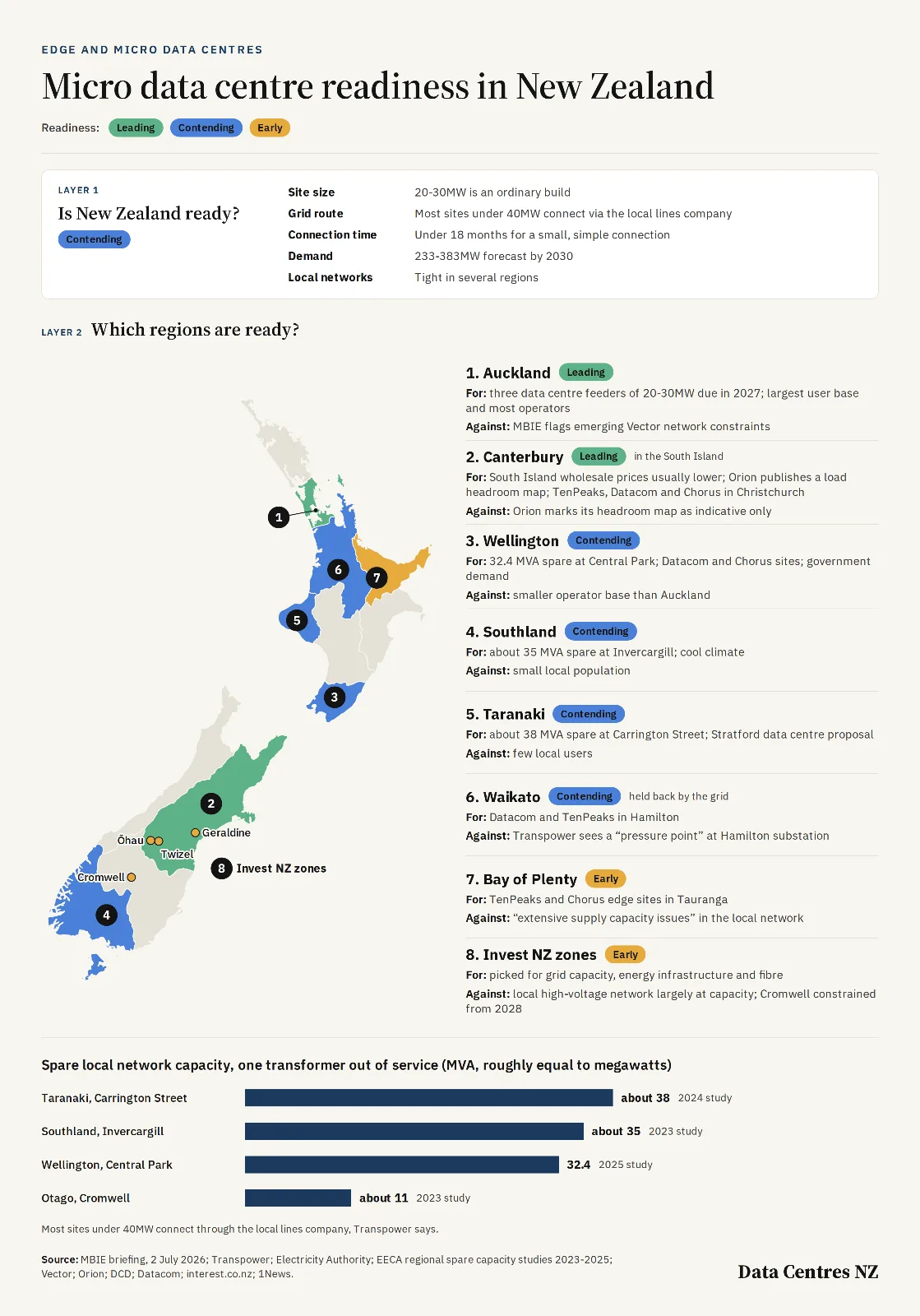
Region | Readiness | Why |
|---|---|---|
1. Auckland | Leading | Three data centre feeders of 20-30MW due in 2027, the largest user base and most operators; MBIE flags emerging Vector constraints |
2. Canterbury | Leading, in the South Island | South Island prices usually lower, Orion's public headroom map, and TenPeaks, Datacom and Chorus sites in Christchurch |
3. Wellington | Contending | 32.4 MVA of spare capacity at Central Park, Datacom and Chorus sites, and government demand |
4. Southland | Contending | About 35 MVA spare at Invercargill and a cool climate, with a small local population |
5. Taranaki | Contending | About 38 MVA spare at Carrington Street and a data centre proposal at Stratford |
6. Waikato | Contending, held back by the grid | Datacom and TenPeaks in Hamilton, where Transpower sees a substation pressure point |
7. Bay of Plenty | Early | Edge sites in Tauranga, but "extensive supply capacity issues" |
8. Invest NZ zones | Early | Picked for grid and energy infrastructure, but local networks are constrained |
Source: MBIE; Transpower; Electricity Authority; EECA regional spare capacity studies, 2023-2025; Vector; Orion; DCD; Datacom; interest.co.nz; ODT; 1News. Spare capacity is measured with one transformer out of service.
1. Auckland: leading. MBIE's briefing lists three new power connections, known as feeders, for data centres in early 2027: 30MW at Takanini for TenPeaks, 30MW at Silverdale for CDC and 20MW at Henderson for Microsoft. Each sits in the size range the AI labs are shopping for. Auckland also holds the AWS and Microsoft cloud regions and most of the operating capacity among New Zealand data centres. The same briefing flags "potential emerging constraints on Vector network (Auckland)", and Vector publishes a hosting capacity map for new load, last updated in July 2026.
2. Canterbury: leading, in the South Island. Christchurch has three TenPeaks facilities, Datacom's Gloucester facility and a Chorus EdgeCentre. Over five years, wholesale prices at Ōtāhuhu in Auckland and Benmore in the South Island differed by more than $20/MWh about 30% of the time, with "usually lower prices in the South Island", the Electricity Authority found. Orion publishes a load growth map showing headroom for new load from 2025 to 2029, which the lines company marks as indicative. Canterbury has the South Island's largest city and its largest operator base.
3. Wellington: contending. The Central Park substation had 32.4 MVA of spare capacity in EECA's September 2025 study, the newest of the regional reports. Datacom runs its Abel facility in the city, Chorus has an EdgeCentre, and central government agencies, a natural customer base for small sites, are headquartered there.
4. Southland: contending. Invercargill had about 35 MVA of spare capacity in EECA's 2023 Southland study, and its cool climate cuts cooling costs. Southland's data centre story so far is one large campus, and Datagrid's consents have held: Environment Southland declined a request to review its water consent on 22 September 2026, saying the consented take is "less than 10 percent of the limit" in the regional plan, the ODT reported. A small population limits local demand for inference.
5. Taranaki: contending. The Carrington Street substation near New Plymouth had about 38 MVA of spare capacity on 2023 loading, EECA's Taranaki study shows. Contact Energy and CDC are assessing a data centre at Stratford that would use an existing grid connection, though neither has committed to build.
6. Waikato: contending, held back by the grid. Datacom runs its Kapua facility in Hamilton and TenPeaks has an edge site there. Transpower calls the Hamilton substation a "pressure point" and expects peak demand on the Waikato regional network to rise from 337MW to 400MW by 2030. It plans to consult on a shortlist of options in late 2026 and to submit a major capital expenditure proposal to the Commerce Commission in the first half of 2027, its project page shows. That investment would move Waikato up this ranking.
7. Bay of Plenty: early. TenPeaks and Chorus both have edge sites in Tauranga, but EECA's 2024 study found "extensive supply capacity issues affecting Tauranga, Kaitemako and Rotorua" in the Bay of Plenty network.
8. The Invest New Zealand zones: early. Invest NZ has named Twizel, Ōhau, Geraldine and Cromwell as data centre zones for their "convergence of existing grid capacity, energy infrastructure, proximity to backhaul fibre and further renewable energy development potential", 1News reported. The local networks are the constraint. EECA's South Canterbury study says much of the region's high-voltage transmission network "is at capacity" and found very little capacity available at Tekapo A. Cromwell had about 11 MVA of spare capacity, with a cable rating expected to become a constraint from 2028, EECA's Otago study found. "This is our home, our landscape, our businesses and our community," Twizel Community Board chair Mary Murdoch told 1News.
What to watch
Auckland's 2027 feeders. The Takanini and Silverdale connections are due on 28 February 2027 and Henderson on 31 March 2027, according to MBIE.
Transpower's Waikato shortlist. Consultation is due in late 2026, ahead of a major capital expenditure proposal planned for the first half of 2027.
The investment principles. Whether the government sets a size threshold, and where, will decide how small sites are treated.
A 20-30MW lab deal in New Zealand. Neither Anthropic nor OpenAI has named a New Zealand deployment. The data centre power list tracks who is building.