At a glance
BusinessNZ's director of advocacy, Catherine Beard, wrote in the NZ Herald on 14 November that data centres can give generators the large, steady demand they need to build.
Her conditions are predictable rules, welcoming rules for overseas investment and big energy users that commit to taking part of the output.
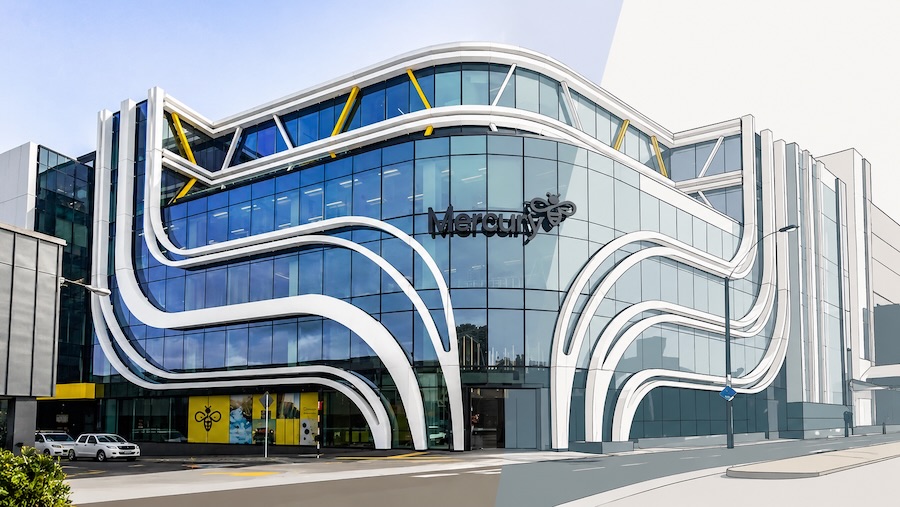
Mercury's go-ahead for its 192MW Puke Kapo Hau wind farm in Otago was supported by its 140MW power option with Datagrid, RNZ reported.
Between May and September, thermal generation was 54 per cent lower than in the same months of 2023, on Transpower's figures, as more wind, solar and geothermal ran.
National, Labour, the Greens and the Opportunity Party each want large AI data centres to secure their own power supply.
BusinessNZ wants data centres to become the big, long-term customers that give New Zealand's power companies the confidence to build new renewable generation.
Its director of advocacy, Catherine Beard, wrote in an opinion piece in the NZ Herald (subscription) on 14 November that "one of the best opportunities in front of us is the global need for more data centres." BusinessNZ says it speaks for thousands of businesses through regional groups such as the Employers and Manufacturers Association. Its energy council calls it "New Zealand's largest business advocacy body".
Expensive energy has already cost New Zealand's regions jobs. Over the last five years, large energy users in pulp and paper, wood processing and food manufacturing have closed or scaled back, costing thousands of jobs in total, she wrote.
"Data centres can provide the large, predictable demand that helps underpin new generation," she wrote. If that demand gives a generator the confidence to build, a data centre can become a new customer helping to support more supply, rather than drawing only on existing electricity.
Mercury and Contact Energy told investors this year that long-term data centre contracts help them fund new power stations.
BusinessNZ wants large energy users to commit to new generation
For that investment to happen, BusinessNZ wants "regulatory predictability, reducing sovereign risk from political flip-flops, bans or threats to break up companies; welcoming overseas investment rules; and cornerstone energy users that can commit to taking a portion of the energy."
A cornerstone user is a large customer whose long-term contract helps a generator finance a new project. Such customers help to de-risk the investment and give generators the confidence to build, Beard wrote.
That investment has started, on Beard's figures, with generators building 17 new renewable projects that would add around 30 per cent to current generation. It has already cut forward electricity prices by a quarter in the past 12 months, she wrote. Fast-track consenting has helped, she wrote, and red tape affecting the cost and speed of new generation should be "proportionate rather than extortionate". BusinessNZ also wants more spending on power lines.
Data centres have run in New Zealand for around 40 years, and concerns about their electricity and water use should be taken seriously, Beard wrote. New developments will still have to meet environmental rules and pay the appropriate costs of connecting to the grid, she added. Officials made a similar point in a July briefing to the government: a new data centre pays for its own connection assets at the edge of the grid and takes a share of core grid costs.
A 140MW Datagrid deal helped Mercury approve its Otago wind farm
Mercury broke ground on the NZ$506 million Puke Kapo Hau wind farm west of Dunedin on 10 November. RNZ reported that "Mercury previously confirmed the decision to approve the expansion was supported by the agreement with Datagrid."
That agreement is a 15-year option over 140MW. It covers Datagrid's AI data centre campus at Makarewa, north of Invercargill. When Mercury bought into Datagrid in July, chief executive Stew Hamilton said in its release that "long-duration demand from large electricity users like Datagrid NZ provides us with the revenue certainty that underpins our investments in new renewable generation developments."
At Contact Energy's annual meeting on 16 September, then chair Rob McDonald said properly structured data centre deals add new demand that underwrites new energy supply. The 250MW Stratford data centre that Contact is proposing with CDC Data Centres depends on consent, finance and anchor tenants, the first large customers whose contracts underpin a build.
Microsoft backed Contact's Te Huka Unit 3 geothermal station, and Amazon Web Services backed Mercury's Turitea South wind farm, according to the officials' briefing.
Thermal generation fell 54 per cent from May to September as new renewables ran
Geothermal, wind and solar stations together produced about 2,100GWh more from May to September than in the same months of 2023, BusinessDesk reported (subscription) from Transpower's weekly market report for the week to 8 November. Hydro inflows were broadly similar in the two periods, the report says.
Thermal generation fell 54 per cent over the same comparison. In September alone, thermal generation dropped from 333GWh in 2023 to 43GWh this year.
Between the end of May and the end of September, hydro storage rose slightly, from 3,053GWh to 3,127GWh. Over the same months of 2023 it fell from 4,295GWh to 2,665GWh. Transpower cautioned that an extra gigawatt-hour of renewable output does not automatically save the same amount of water, because prices, transmission limits and system conditions also shape the outcome.
Forsyth Barr estimates that 1,736MW of new renewable capacity is under construction, BusinessDesk reported. A further 4,784MW has been consented, and whether those projects go ahead depends partly on expected demand, BusinessDesk wrote.
Transpower's latest list holds 14 data centre projects
Transpower's connection list, last updated on 8 November, holds 14 data centre projects with 1,830MW between them, up from 1,010MW in May. The figures are the most each connection could supply, not expected demand.
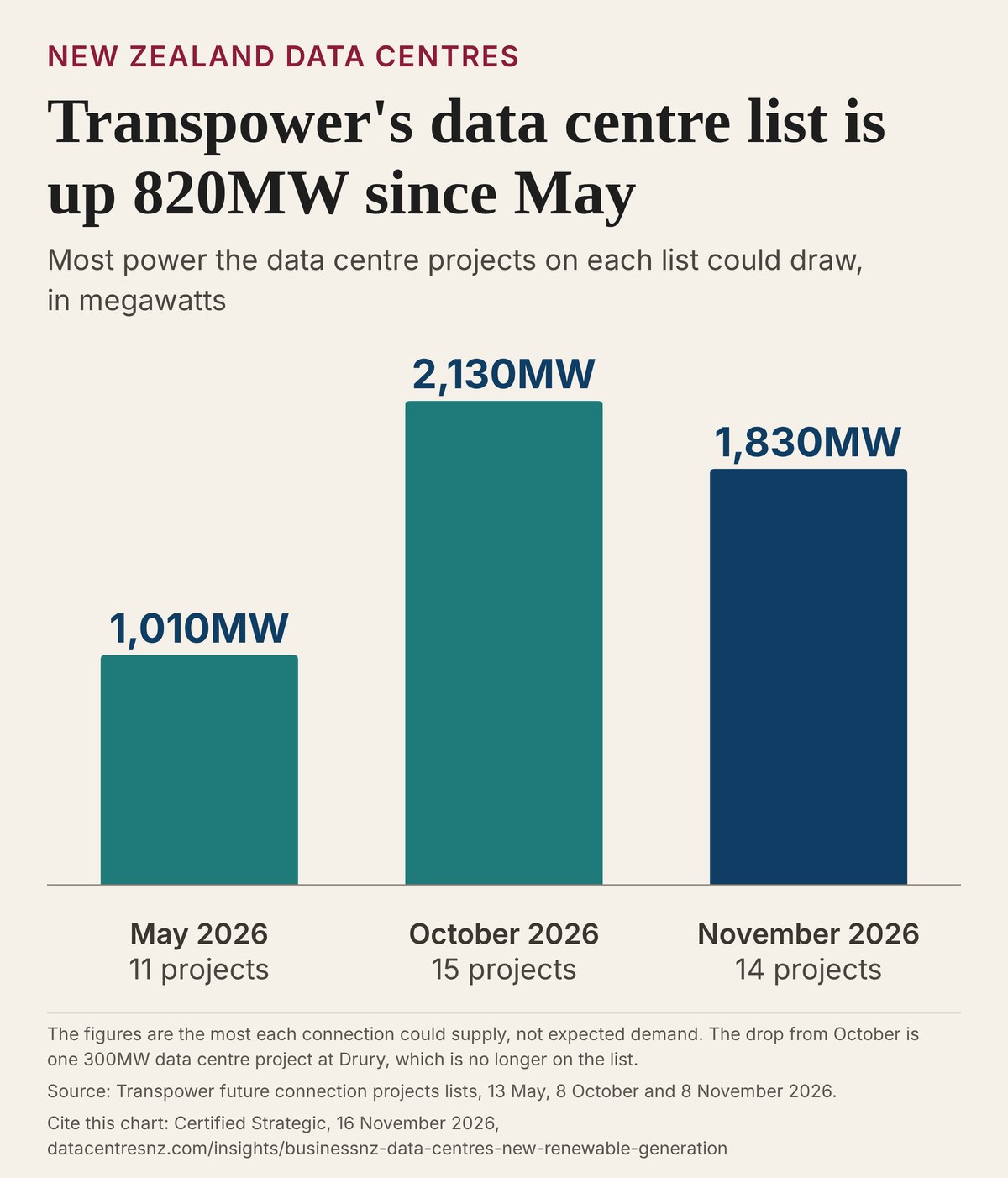
The October list held 2,130MW. The drop since then is one 300MW data centre project at Drury, south of Auckland, which is no longer on the list.
By August, data centre developers had made 30 approaches to Transpower, and the 11 that had moved to assessment or design added up to a gigawatt, Boston Consulting Group reported.
Hamilton told analysts in August that two data centre projects, and maybe one more, "will probably consume our ability to build power stations over the next 5-10 years". Contact chief executive Mike Fuge said on his results call that "this is not a build it and they will come strategy".
National promises to make AI data centres bring their own power
National's Electrify NZ 2.0 plan promises to "require AI data centres to bring their own new, firmed power, so new digital investment adds to the grid and creates jobs instead of pushing up prices." Firmed power is supply that can run on demand, whatever the weather.
National, Labour, the Greens and the Opportunity Party each want large AI data centres to secure their own power supply. The official result is due on 27 November. Coalition talks start then, Prime Minister Christopher Luxon has said.
Officials told Economic Growth Minister Nicola Willis in July that they did not expect the data centres planned at the time to raise power prices.
New Zealand needs generators prepared to build, investors prepared to put capital at risk and customers prepared to make long-term commitments, Beard wrote. "If we make those partners welcome, we can turn renewable energy into a genuine competitive advantage for the New Zealand economy," she wrote. "If we don't, they will go elsewhere."
What to watch
Official election result, 27 November: the Electoral Commission releases the official count, and coalition talks then decide whether an own-power rule for data centres goes into the next government's agreement.
Datagrid's investment decision: Datagrid expects to commit to the Makarewa build before the end of 2026.
First power from Puke Kapo Hau: the wind farm is due to start generating in the April to June 2028 quarter, the same year Datagrid targets for its first 280MW stage.