
At a glance
New Zealand runs about 208MW of colocation across 36 facilities, with nine more upcoming.
CDC, Datacom, TenPeaks and Datagrid sell four different things out of buildings that look alike from the road.
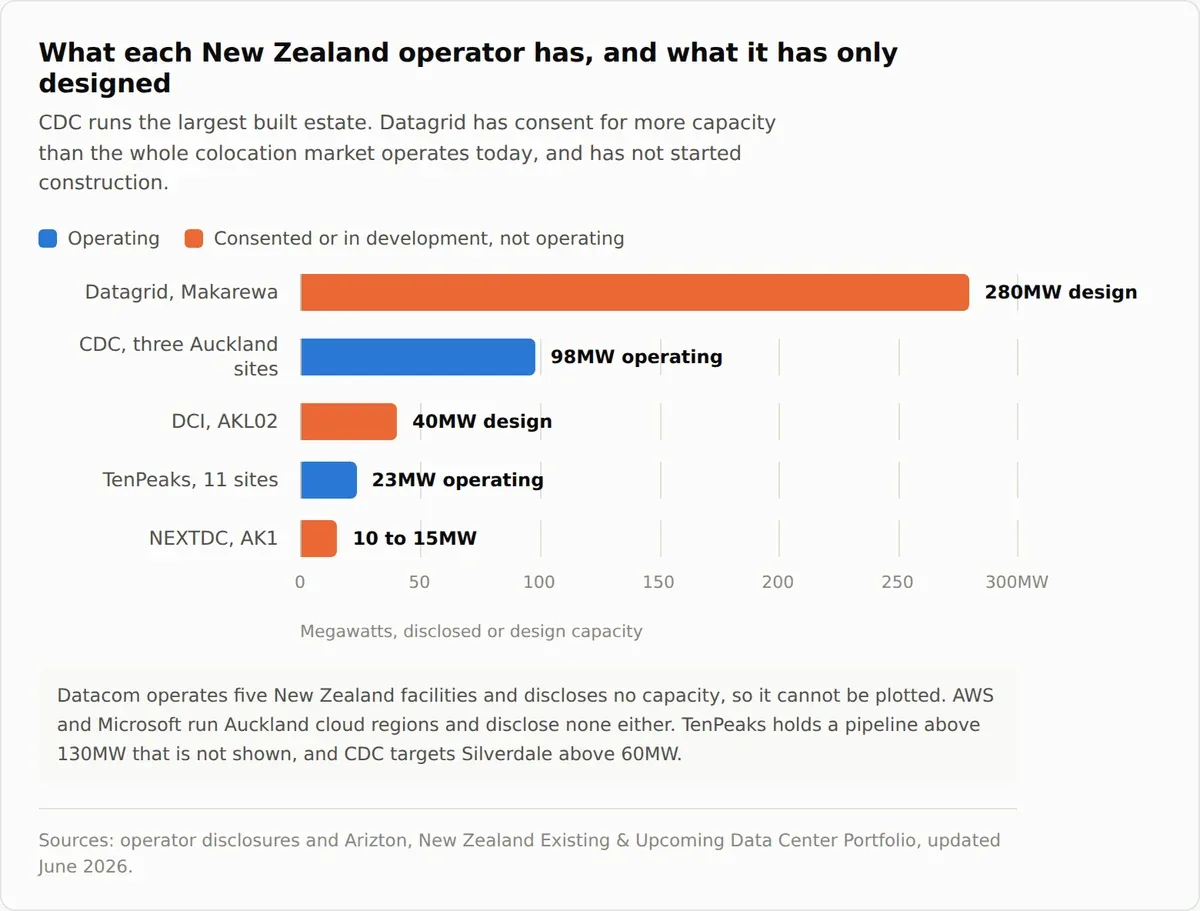
Datagrid's consented Southland campus is designed for 280MW, more than the whole colocation market operates today.
That campus has NZ$53 million of equity behind it and no Transpower connection agreement yet.
Tenant lists stay confidential. Resource consents, cloud policy, listed filings, gentailer deals and region announcements fill the gap.
New Zealand's colocation market runs about 208MW today
A data centre is a secure building filled with servers, storage and networking equipment, kept running by constant power and constant cooling. Payments, tax filings, health records, streaming and AI queries all run on them. The cloud is a network of these buildings, and the named operating capacity sits mainly in Auckland.
The operating market totals around 208MW across 36 existing colocation facilities, with nine more upcoming, on Arizton's June 2026 portfolio study. Arizton names CDC, DCI and Datacom as the operators holding most of the installed capacity. That count covers colocation, so the AWS and Microsoft Auckland regions sit outside it. The Electricity Authority has separately logged 12 prospective projects, citing confidentiality over their location and capacity.
Data centre consenting entered the election campaign on 26 July, fourteen weeks before the vote. The Green Party called that day for a one-year moratorium on consenting new AI data centres. Prime Minister Christopher Luxon rejected the pause and directed officials to develop investment principles instead, framed as a compact: what a builder would have to contribute to get in. New Zealanders vote on 7 November.
What CDC, Datacom, TenPeaks and Datagrid each sell
CDC builds campuses for government, defence and enterprise workloads. Hobsonville Campus Two runs at 54MW, the largest operating facility in the country on disclosed capacities; Hobsonville One and Silverdale One each run 22MW, with Silverdale targeted above 60MW. CDC is 49.72 per cent owned by Infratil, the NZX and ASX listed investor managed from Wellington by Morrison. Infratil's independent valuation put CDC at an A$18.5 billion midpoint at 30 June 2026.
Datacom runs five New Zealand facilities, serving domestic corporate and public sector IT. TenPeaks, carved out of Spark with Pacific Equity Partners taking 75 per cent, operates 23MW of IT load across 11 sites and holds a development pipeline above 130MW on owned land across three Auckland campuses.
Datagrid is building a single campus designed for 280MW, against a national colocation market of about 208MW. Its Makarewa campus was consented in March 2026 by Southland District Council, Environment Southland and Invercargill City Council on a non-notified basis, which 1News reported as the first New Zealand data centre approved that way. The site holds a 360MW grid connection and an initial data centre design of 280MW. What is funded so far is the NZ$53 million Mercury paid for its stake, which Galasso has said lets the company begin horizontal works, with a final investment decision expected later in 2026. Transpower's connection remains at the investigative stage, and the opening target is 2028. Mercury holds a 15-year power purchase option for up to 140MW, about half that initial design and an option rather than firm supply, plus 12.7 per cent equity for US$30 million. Datagrid has also contracted ASN and OMS Group to build a 2,300km cable from Invercargill to a landing at Torquay in Victoria, targeted for service in 2029.
Galasso has said New Zealand's remoteness is now an advantage, and describes the Southland campus as the anchor tenant that makes the cable viable. Sharon AI's US$1.32 billion five-year contract is the largest AI cloud contract disclosed for the country.
Five public records show what a New Zealand facility discloses
Tenant lists are commercially confidential. Five public records still carry most of what a buyer or a neighbour would want to know.
Resource consents. Under the Resource Management Act, territorial authorities handle land use and regional councils handle water take and discharge, with Auckland Council doing both as a unitary authority. Consent conditions disclose cooling method, water take limits, noise envelopes and construction staging. RNZ reported Datagrid was granted 10 resource consents for Makarewa. Where a consent is processed non-notified, planners decide it without public submissions and without third-party appeal rights, so the file exists on request while the process itself produces no public hearing record.
Government cloud policy. The Cloud First policy requires government organisations to use public cloud services where possible. It permits data classified RESTRICTED and below to sit offshore, and says agencies should over time store RESTRICTED information in a New Zealand based data centre where a suitable onshore service exists, with adoption decided case by case after a risk assessment. That policy, plus the Government Chief Digital Officer's cloud framework agreements, is what a buyer reads to work out whether a workload can stay onshore.
Listed company disclosures. Infratil reports CDC's capacity, contracts and valuation to the NZX and ASX. Spark's disclosures carried TenPeaks through its carve-out.
Electricity and generation deals. A gentailer contract sizes a campus before a single rack lands. Mercury's option covers up to 140MW, about half Makarewa's initial design, and the Electricity Authority's register of prospective projects shows how many more are in the queue even when the details stay confidential.
Hyperscaler region announcements. AWS and Microsoft both operate Auckland cloud regions. Each publishes a service list for its region, which tells a buyer whether a given workload can stay onshore. Capacity and building addresses stay off the page.
Inside the building: servers take 60 per cent of the power
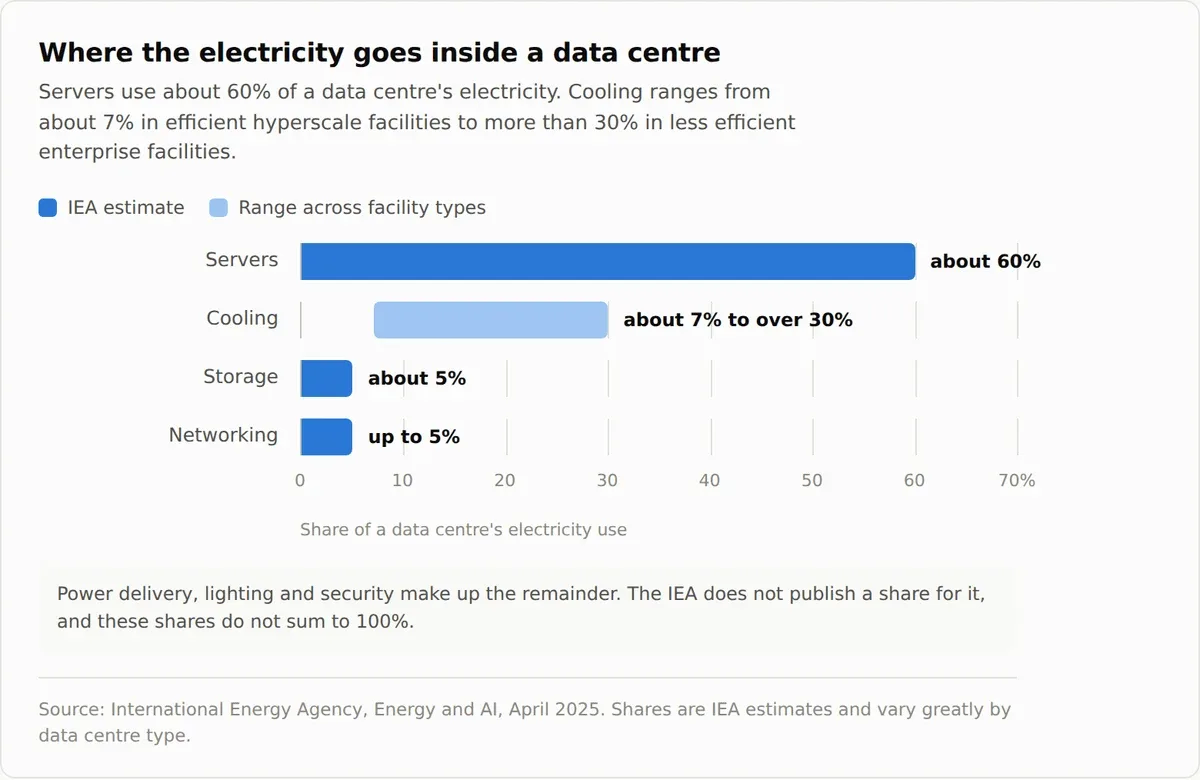
Most of a data centre's electricity goes to the machines themselves. The International Energy Agency puts servers at around 60 per cent of a data centre's electricity, storage at about 5 per cent and networking at up to 5 per cent. Cooling ranges from as little as 7 per cent in an efficient hyperscale build to more than 30 per cent in an older enterprise room.
Load inside the building | Share of electricity | What it does |
|---|---|---|
Servers | ~60% | Runs payments, IRD and health records, streaming and AI tools |
Storage | ~5% | Holds every record, backup and photo library |
Networking | up to 5% | Moves data between buildings and to your phone |
Cooling | ~7% efficient hyperscale to 30%+ older enterprise | Removes the heat the computers make |
Power delivery and building systems | remainder | Conversion losses, lighting, security |
Source: IEA, Energy and AI, April 2025. Shares are IEA estimates and vary by facility type.
A consent sets the outer limit on a site's water take, and that ceiling is a maximum rather than a forecast of use. Datagrid's Environment Southland permit, dated 11 March 2026, sets a ceiling of 7 litres a second, or 604,800 litres a day and about 220 million litres a year. Rémi Galasso, Datagrid's founder and chief executive, told Datacentres NZ that Southland's climate lets the campus run "a closed-loop liquid system cooled naturally by the outside air, which means that for most of the year we don't touch water at all", and that the campus is engineered to target one of the lowest water consumption figures in Asia Pacific, with firm volumes due alongside the finalised design.
Alan Brent, Professor and Chair in Sustainable Energy Systems at Te Herenga Waka Victoria University of Wellington, and Andrew Crossland, Professor in Practice in engineering at Durham University, wrote on 31 July that work such as model training and batch processing can be scheduled into hours when renewable generation is plentiful. They cite a Transpower estimate that every gigawatt of peak demand avoided could save around NZ$1.5 billion in system costs.
AI-purpose facilities are built differently again, around denser racks and different cooling: see what an AI data centre is.
What to watch
The investment principles. Luxon directed Economic Growth Minister Nicola Willis and the Department of the Prime Minister and Cabinet to develop them, with MBIE engaged and input sought from the energy sector and operators. A release date and the legal form the principles will take both remain open.
Australia's timetable. The Australian government published five expressly non-binding national expectations for data centres on 23 March 2026. On 15 July it announced a separate package covering new power supply, full grid connection costs and water infrastructure, which it expects to legislate in early 2027. Labour leader Chris Hipkins has said he agrees with "a heck of a lot" of "the Australian AI framework".
Makarewa construction. Consent is granted and the opening target is 2028. Transpower's connection work sits between the consent and the 2028 target, alongside financing Datagrid has not confirmed. The wider build pipeline tracks both.