At a glance
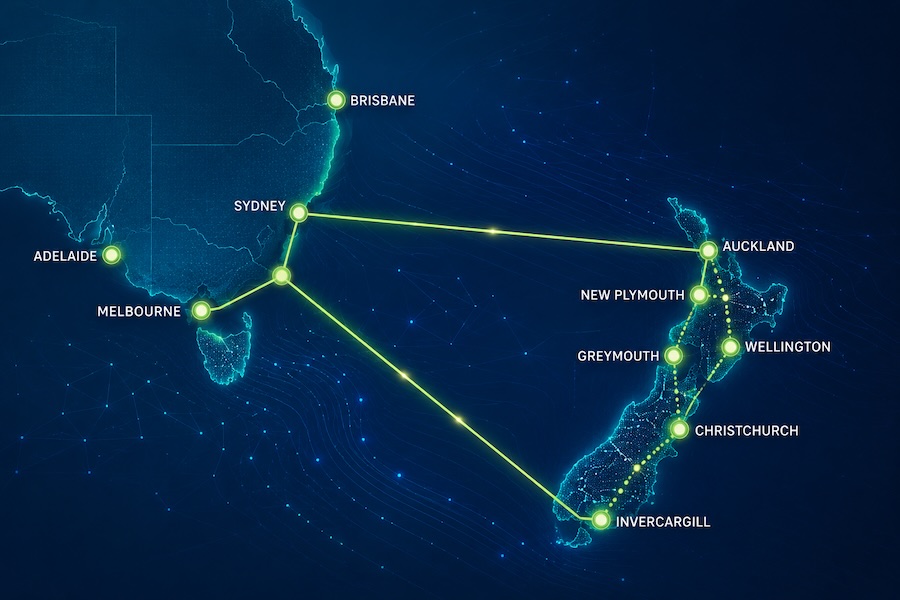
Datagrid has signed a supply and installation contract with Alcatel Submarine Networks and OMS Group for the Tasman Ring Network's first phase, 2,300km from Invercargill to Melbourne.
The cable will carry at least eight fibre pairs with a design capacity of at least 160 terabits per second, and will be the first international submarine cable to land in the South Island.
Datagrid says latency between the South Island and Australia improves by up to 45%, a minimum of 19 milliseconds round trip, against today's routes via the North Island.
The Australian end lands at Torquay in Victoria with backhaul to Melbourne, and the ready-for-service target is 2029, a year after Makarewa's targeted 2028 opening.
The contract covers phase one only, with the rest of the 6,000km ring through Sydney and Auckland held as an option.
Datagrid contracts ASN and OMS Group for the 2,300km build
The South Island's first direct route to the world is under contract. Datagrid announced on 31 July that it has signed a supply and installation contract for the Tasman Ring Network, a 2,300km optical submarine cable between Invercargill and Melbourne. Alcatel Submarine Networks, the French cable maker known as ASN, will supply the system. Malaysia's OMS Group will run the marine survey and install the cable.
The signatures move the Tasman Ring from feasibility work to a committed build. OMS Group will survey the route with the ELITE, its long-range uncrewed surface vessel, which the company says cuts the fuel use and carbon footprint of survey operations while collecting high-precision seabed data. "We are honoured to have been selected by Datagrid New Zealand, alongside ASN, to deliver the Tasman Ring Network," OMS Group chief executive Ronnie Lim said in the announcement. ASN chief executive Alain Biston said the route's impact "will undoubtedly be significant for the economic development of New Zealand".
Eight fibre pairs open a second gateway in the south
Every international cable serving New Zealand today comes ashore in the North Island. The Tasman Ring will be the first to land in the South Island, opening what Datagrid describes as a second, fully independent gateway in the south and a new digital route across the Tasman Sea. The system is specified at a minimum of eight fibre pairs and a design capacity of at least 160 terabits per second.
Datagrid chief executive Rémi Galasso says the cable cuts latency between the South Island and Australia by up to 45% against existing routes via the North Island. Head of connectivity Pierre Goiffon told iTnews that works out to a reduction of at least 19 milliseconds round trip. Galasso named South Island IT companies, universities and research centres as the users the shorter path serves, a regional case that sits alongside the investment questions running through New Zealand's wider data centre build-out.
The Australian end lands at Torquay, service targeted for 2029
The Australian end comes ashore at Torquay, the Victorian surf town that SUBCO's SMAP hypercable also uses as a landing, giving Victoria an international route that terminates in Melbourne rather than Sydney. Goiffon told iTnews the cable "will land in Torquay, where other submarine cables have recently landed", with a terrestrial backhaul extending it to Melbourne and a ready-for-service target of 2029. The link will run as an Open Cable system, separating the optical circuit from the transmission equipment so capacity owners can light it with their own gear.
The contract covers the first phase of the ring, with the rest held as an option. "Today we announce the signature of the supply and installation contract for the first phase of the Tasman Ring Network project which provides connectivity from Invercargill to Melbourne with an option to build the rest of the system at a later stage," Goiffon said. The full 6,000km design, announced with Chorus in December 2024, spans Invercargill, Melbourne, Sydney and Auckland, with New Plymouth and Greymouth joined by a coastal route. Chorus has confirmed it is not involved, saying in its FY25 results that the project "did not meet our investment criteria". The Tasman Ring has also superseded Te Waipounamu, the Invercargill to Sydney and Melbourne cable Galasso's Intelia proposed in 2024.
Makarewa targets 2028, a year ahead of its cable
The route exists to serve Datagrid's AI campus at Makarewa, north of Invercargill, consented in March 2026 at an initial design of 280MW on a 360MW grid connection. Mercury bought 12.7% of Datagrid for US$30 million in July, adding equity to the 140MW power purchase option it signed in March. The campus pitch is renewable South Island power sold offshore as compute, and the cable is the route that carries it.
On current targets the campus opens in 2028 and the cable enters service in 2029, so Makarewa's first traffic would run over existing routes via the North Island. As New Zealand's government drafts its data centre investment principles, Datagrid has not disclosed the contract value or how the cable build is financed, and its final investment decision on the campus is expected before the end of 2026.
What to watch
The final investment decision on Makarewa, expected before the end of 2026, remains the campus gate, with a debt facility and a firm conversion of Mercury's 140MW option still to come. OMS Group's uncrewed survey vessel runs the route next, the cable's first physical milestone. The option over the Sydney and Auckland legs would restore the full ring if exercised, and Datagrid has named 2029 as the ready-for-service target for the South Island's first international cable. Our Australian edition has what the Torquay landing adds to Victoria's subsea capacity.