At a glance
Chorus will sell precision timing over its fibre network, starting progressively from early 2027 in Wellington, Auckland and Christchurch.
The timing signal will come from the Measurement Standards Laboratory's atomic clocks in Lower Hutt, which keep official New Zealand time.
Mobile cores, trading systems and distributed databases each need clocks agreeing to within microseconds.
Data centre tenants get precise time today from a rooftop satellite receiver or an internet time server.
Chorus has named the cities and the launch window, and the accuracy class, the price and how long the service rides out a fault are still to come.
Chorus TimeSync starts in three cities from early 2027
Chorus has announced a service that would let a data centre take precise time off its fibre connection, sourced from the atomic clocks that keep official New Zealand time. TimeSync is expected to be introduced progressively from early 2027, starting with Wellington, Auckland and Christchurch, sold as an add-on to existing Chorus fibre products and as a standalone.
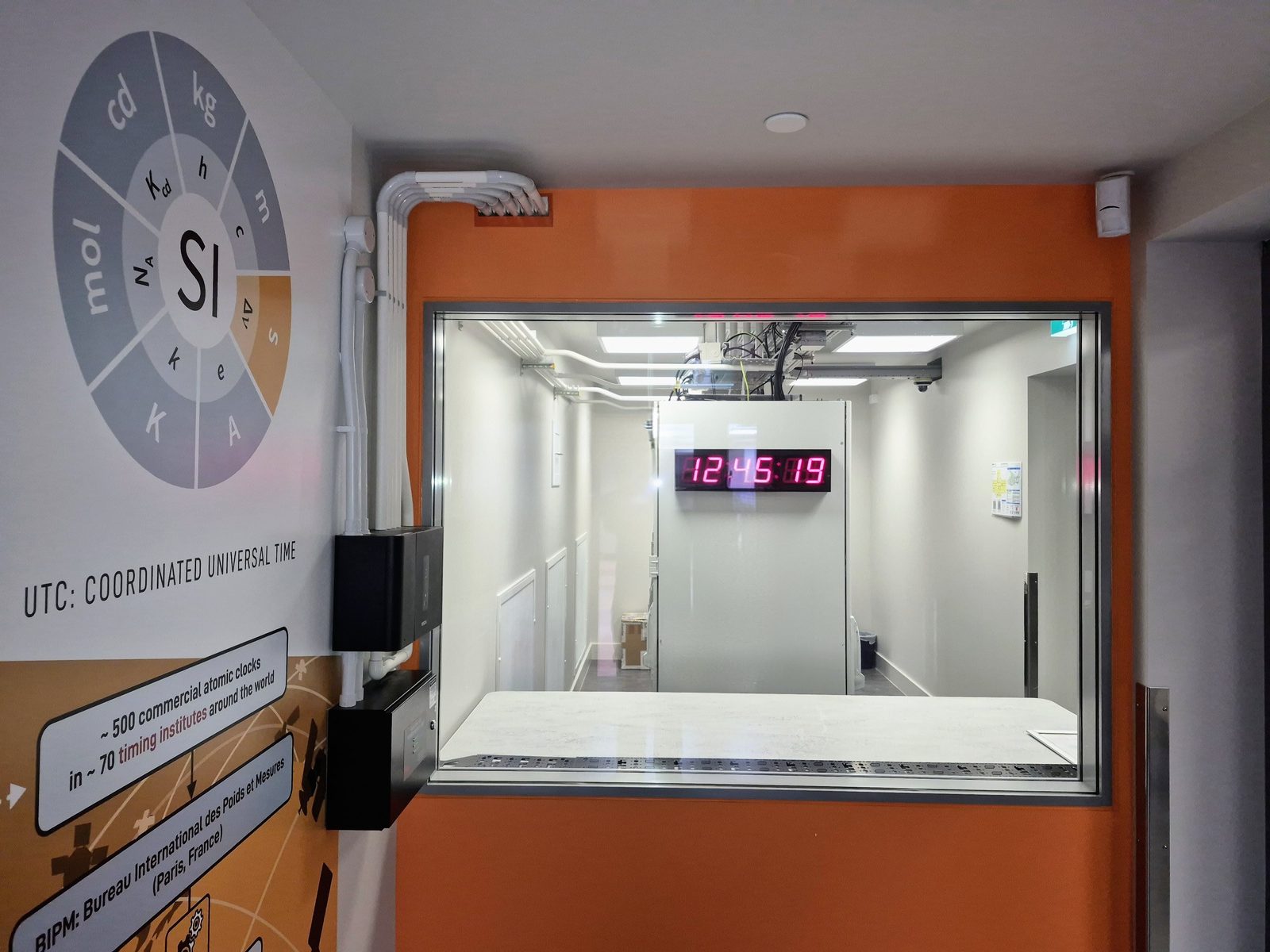
Chorus says its fibre network will link to Coordinated Universal Time derived from the Measurement Standards Laboratory's atomic clocks, and that the first phase integrates a highly accurate atomic clock and deploys high-accuracy timing infrastructure across the network. MSL is New Zealand's national metrology institute and the keeper of official New Zealand time.
Chorus, New Zealand's largest fixed-line network operator, built most of the government-sponsored Ultra-Fast Broadband network and sells wholesale to retail service providers such as Spark, One NZ and 2degrees. It calls TimeSync the country's first wholesale network-based precision timing service. Chief technology officer Martin Sharrock said the importance of diversified timing has grown "especially in light of recent international network disruptions", and that satellite systems "can be vulnerable to interference, severe weather events, geopolitical impacts and other external factors".
Mobile cores, trading systems and databases set the tolerance
Mobile networks carry the tightest requirement, and operators put their cores and aggregation sites in data centres. Nokia, which is supplying the technology for TimeSync, says multi-band GNSS receivers in its routers reach primary reference time clock class B accuracy, within 40 nanoseconds of UTC, against 100 nanoseconds for single-band receivers at class A, while older networks with partial on-path timing support target about 1.5 microseconds. On a base station relying on built-in oscillators, Nokia says, "the gNB synchronization would degrade and wander from the primary reference time clock, potentially causing it to interfere with other neighboring cells".
Trading venues timestamp every order and every trade against a common reference, so a regulator can lay one venue's record against another's and see which came first. Matching engines and the firms trading against them sit in the same colocation halls, so the reference has to reach the rack.
Distributed databases have tightened fastest. Amazon extended microsecond-accurate time to another 26 EC2 instance types across all commercial regions in June 2026, having first offered microsecond accuracy in November 2023. Yugabyte reports a threefold latency improvement and double the throughput on the service, because a wide uncertainty window between nodes forces transactions to restart and a tighter clock bound produces fewer restarts.
Data centres get precise time today from satellites or from NTP
A facility that needs better than a millisecond installs its own reference, which means a satellite antenna with a clear sky view, a cable run down to a grandmaster clock in the rack, and a maintenance obligation on all of it. The alternative is time off the public internet from an NTP server, cheap and typically accurate to a few milliseconds rather than microseconds.
Chorus is proposing a third route: time delivered over the fibre already reaching the building, which would take the antenna and the roof access off an operator's asset register. MSL already distributes official time over the internet, maintaining UTC(MSL) as the New Zealand time standard and running stratum 1 NTP servers available for connections within New Zealand. Its director and chief metrologist since September 2025, Peter McDowall, called precise timing "the invisible heartbeat keeping our modern networks synchronised, trusted and running".
Route | Where the time comes from | Availability |
|---|---|---|
GNSS receiver on site | Satellite constellations overhead | Anywhere with a sky view, today |
MSL stratum 1 NTP servers | UTC(MSL) atomic clocks, Lower Hutt | Within New Zealand, today |
Chorus TimeSync | UTC derived from MSL atomic clocks | Wellington, Auckland and Christchurch from early 2027 |
Source: Measurement Standards Laboratory and the Chorus announcement, 5 August 2026.

Image: Supplied
The first three cities include Auckland, which holds most of New Zealand's colocation capacity and both hyperscaler regions. Datagrid's 280MW Makarewa campus and the Tasman Ring cable landing are in Southland, and every new site in New Zealand's data centre build needs power, fibre and a time reference.
EASA warns of worsening satellite jamming and spoofing
The European Union Aviation Safety Agency issued a revised safety bulletin on 3 July 2026, SIB 2022-02R4, addressing what it calls the growing severity and sophistication of GNSS jamming and spoofing incidents. It is directed at national authorities, air traffic managers, air navigation service providers, airlines and equipment makers. The same constellations carry the timing that banks, grids and telecommunications networks run on.
A satellite timing chain depends on two parties outside the operator. Roof access for the antenna is usually the landlord's to grant, and the constellations are run by foreign states and agencies. A fibre-delivered reference would move that dependency onto a single domestic supplier.
Deutsche Telekom and TOP IX already sell fibre-delivered time in Europe
Deutsche Telekom's wholesale arm launched Telekom TimeSync in June 2025, a fixed-network service built on the Precision Time Protocol standard and sold with service level agreements. Italian internet exchange TOP IX launched a time-as-a-service offering in March 2025 on Adtran Oscilloquartz grandmaster clocks.
Chorus argues its coverage is the advantage. Sharrock said the network is designed so precise timing can be delivered consistently across the country, which "reduces complexity, avoids unnecessary duplication and makes it easier for mobile operators and businesses to adopt the service". Chorus's fibre services sit under a Commerce Commission price-quality path that caps its maximum revenues.
Equinix delivers satellite time indoors in Sydney with 24 hours of holdover
Australia's National Measurement Institute provides that country's official time and frequency dissemination service and operates NTP servers across Australia traceable to UTC(AUS). Equinix sells a timing product from selected metros including Sydney, and its documentation describes the source as redundant GNSS receivers with antennas inside the data centre, backed by rubidium atomic clocks that hold accuracy within 1.5 microseconds for up to 24 hours if the signal is lost.
Equinix recovers the satellite signal on site and carries it the last few metres to the customer's rack. Chorus is proposing to carry the reference itself over fibre from Lower Hutt. It has yet to publish an accuracy class, a holdover period or a price for TimeSync, or to say where GNSS sits in the chain.