
At a glance
Datagrid's remaining consent for its 280MW Makarewa campus stays on the path the council set in September, after Environment Southland turned down a campaign group's request on 29 October 2026.
The council's letter says the cable and campus would qualify as specified infrastructure, the freshwater category that lets wetland works be decided case by case.
Datagrid's 280MW campus north of Invercargill won its main consents in March 2026 and began construction in August, with opening targeted for 2028.
Datagrid has contracted Alcatel Submarine Networks and OMS Group for its Tasman Ring cable to Melbourne, with service targeted for 2029.
A Southland coalition intends to seek a judicial review, and Datagrid is confident its consenting "met all statutory requirements".
Datagrid's remaining consent for its AI data centre campus at Makarewa stays on the path Environment Southland set in September. The regional council has refused a campaign group's request to let the public make submissions on it. It set out its position in a letter to the group, Stop Data Centres NZ, dated 29 October 2026, Chris Lynch Media reported.
Datagrid is building what it calls New Zealand's largest data centre project, on a 49-hectare site a quarter of an hour north of Invercargill. At its planned 280MW, the Makarewa campus is larger than the roughly 208MW of colocation capacity that Arizton counts across New Zealand's 36 operating facilities. Founder and chief executive Rémi Galasso built the Hawaiki trans-Pacific cable before he started Datagrid.
The group had asked whether the campus still counts as specified infrastructure now that Chorus is no longer a partner in Datagrid's planned cable to Australia. The council's letter says it would, and leaves the final call to the decision-maker.
Environment Southland says the campus is meant to form part of a telecommunications network
"The Council has made its decision on notification of APP-20262269 and cannot lawfully revisit that decision," general manager strategy and regulation Hayley Fitchett wrote. Notification is the step that opens an application to submissions from the public.
Specified infrastructure is a category in New Zealand's freshwater rules. It covers regionally significant infrastructure and services run by lifeline utilities, and it lets a council decide works near a wetland case by case. To grant consent, the council must be satisfied the project will provide significant national or regional benefits and needs to be in that location.
Fitchett wrote that the cable and data centre would meet the definition both as regionally significant infrastructure and as infrastructure delivering a service operated by a lifeline utility. "The proposal is clearly intended to form part of a telecommunications network, and it is reasonable to assume that other connections with such a network will be made upon completion of the development," the letter says. The decision-maker on the remaining application still has to be satisfied the campus qualifies before granting or declining it.
The remaining application appears to be the stormwater and wetland consent Newsroom described in September, after Datagrid lodged a new application with Environment Southland. Datagrid's May site summary describes the removal of a wetland of about 2,000 square metres near the southern end of the site. An independent commissioner, Hugh Leersnyder, endorsed considering the application without public notification on 18 September, Newsroom reported.
Chorus left the Tasman Ring partnership in 2025
Chorus and Datagrid signed an exclusive memorandum of understanding in December 2024 to investigate a cable ring linking New Zealand and Australia. A memorandum of understanding is a statement of intent that commits neither side to build. Chorus said in its 2025 annual report that its memorandum and engagement with Datagrid "ended as the project did not meet our investment criteria".
Datagrid went ahead with the cable on its own. On 30 July 2026 it signed a supply and installation contract with Alcatel Submarine Networks and Malaysia's OMS Group for the Tasman Ring's first phase, about 2,300km from Invercargill to Torquay in Victoria with backhaul to Melbourne. The system is specified at a minimum of eight fibre pairs and at least 160 terabits per second. Datagrid describes it as the first international submarine cable to land in the South Island. Service is targeted for 2029.
Stop Data Centres NZ argued that the original legal opinion behind the specified-infrastructure pathway treated the data centre and cable as one package. The group also pointed to reporting that funding for the cable so far covers a marine survey. Galasso told the New Zealand Herald in July that the rest of the cable will be funded alongside the data centre.
Datagrid has started building at Makarewa
Datagrid won its main consents in March 2026 from Southland District Council, Environment Southland and Invercargill City Council. HEB Construction began the roads and earthworks on 18 August 2026, and Datagrid expects the foundation platforms for the data centre, substation and cable landing station to be complete by the end of the year. It is targeting 2028 for opening.
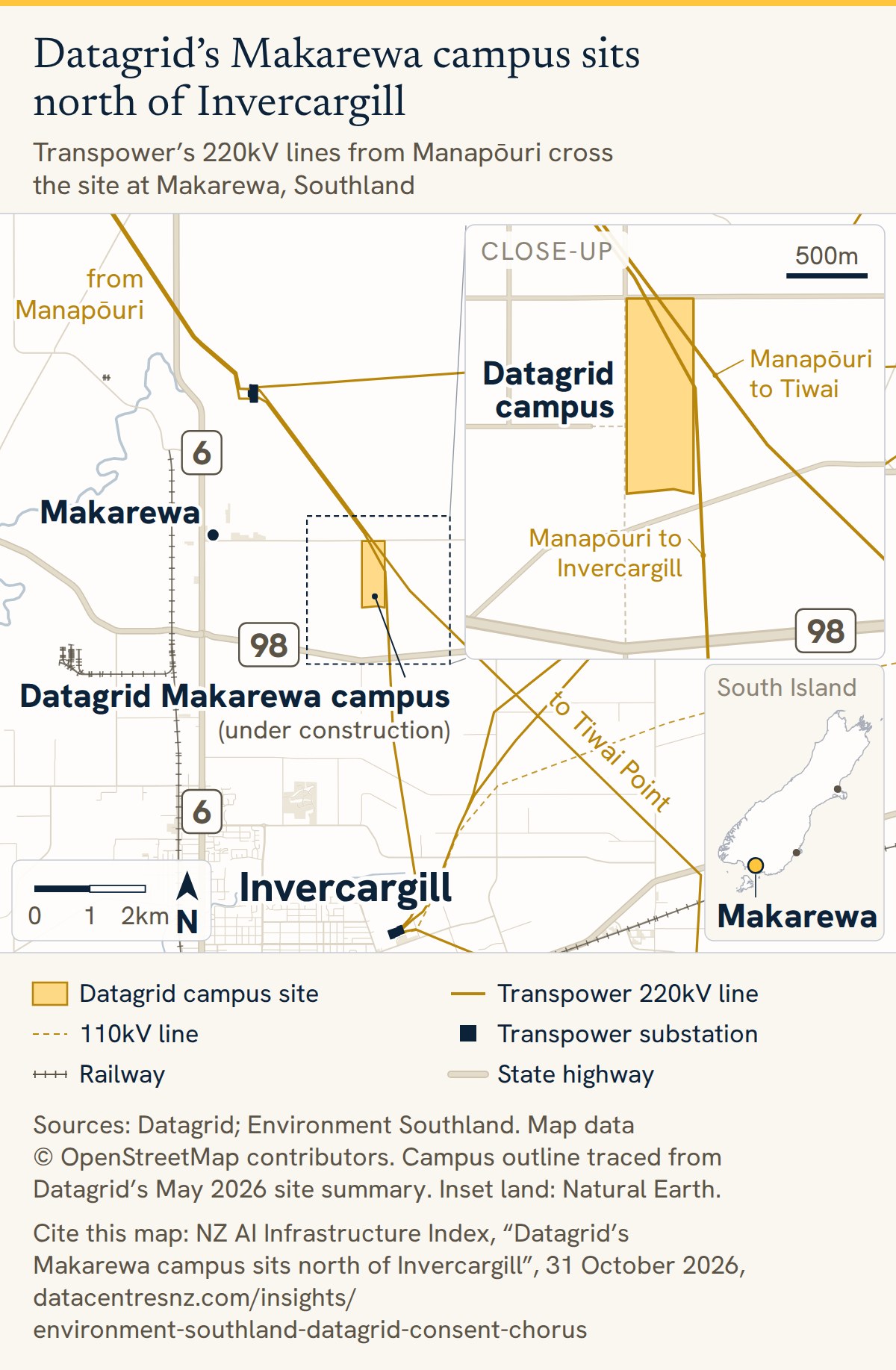
The site has a 360MW grid connection to the South Island network, and Datagrid has pre-paid Transpower for four transformers for its substation. Mercury NZ paid US$30 million for a 12.7 per cent stake in July, adding to a 140MW power purchase option it signed in March. A final investment decision is expected later this year, according to Mercury's July release.
Datagrid's May site summary, released to Newsroom by Environment Southland, replaces the six data halls in the consented design with one building. The footprint falls from 78,000 square metres to about 46,000 to 50,000. A battery system of about 20,000 square metres cuts the diesel backup generators from 84 to about 10, against the fewer than 34 Datagrid gave publicly in August. The summary says no groundwater is needed for cooling, though it still lists bore water for construction and site maintenance. The capacity stays at about 280MW.
A Southland coalition has signalled a High Court challenge
The Southland Sustainable Resource Coalition intends to seek a judicial review of the regional consents. It has put Environment Southland and Datagrid on notice, The Press reported on 30 October. A judicial review asks the High Court to check whether a decision was made lawfully, not whether it was the right one. Chair Kelly Blomfield told The Press significant fundraising would be needed for the challenge. In September, Environment Southland declined the coalition's request to review Datagrid's water take, and an independent commissioner declined its request to review the noise conditions set by Southland District Council.
Galasso told The Press that Datagrid took "a deliberately thorough approach to consenting from the outset, supported by extensive expert assessments". "We are confident the process was robust and met all statutory requirements," he said. Fitchett said Environment Southland "remains confident in the integrity of its decision-making processes".
We expect the remaining application to be decided on the specified-infrastructure test rather than reopened. The council's letter rules out revisiting notification, and an independent commissioner endorsed the non-notified path on 18 September.
What to watch
The wetland decision. The decision-maker on the stormwater and wetland application has to be satisfied the campus is specified infrastructure before granting or declining it.
A final investment decision. Mercury's July release expected it later in 2026.
The foundation platforms. Datagrid expects the platforms for the data centre, substation and cable landing station to be complete by the end of 2026.
A High Court filing. The coalition has given notice of its intention, and a judicial review begins when it files in the High Court.
Source: Environment Southland letter of 29 October 2026, as reported by Chris Lynch Media; Chorus Annual Report 2025; Datagrid releases of 30 July and 18 August 2026; Mercury release (23 July 2026); Datagrid May 2026 site summary, via Newsroom (25 September 2026); New Zealand Herald (30 July 2026); The Press (30 October 2026); Arizton (June 2026).