At a glance
Contact Energy has lodged a resource consent application with Stratford District Council for the 250MW data centre it proposes with CDC Data Centres.
An independent commissioner will assess the application and is expected to say within two to three weeks whether more information is needed.
The company is targeting a final investment decision in mid-to-late 2027, with first operations potentially by the end of 2028, The Post reported.
The project could create 600 construction jobs, another 400 associated positions and about 200 permanent roles, according to The Post.
"We've had strong interest from overseas, but obviously landing the customer is key as well," chief executive Mike Fuge said.
Contact Energy has applied for resource consent for the 250MW data centre it proposes with CDC Data Centres at Stratford in Taranaki. Chief executive Mike Fuge confirmed the application had gone to Stratford District Council, The Post reported on 24 November.
"We put a lot of effort into getting the consent ready and to make sure that the environmental conditions around noise and everything like that were spot on," Fuge told the paper.
The two companies said in August that they would seek resource consent for a data centre near the Taranaki Combined Cycle gas plant Contact retired earlier this year. Infratil owns close to half of CDC and about 9 per cent of Contact. On 18 November, Infratil chief executive Jason Boyes said the project had entered the consenting phase, BusinessDesk reported.
Resource consent is the planning approval a council gives before a project can be built.
Stratford would be CDC's first New Zealand campus outside Auckland.
A 2027 investment decision is Contact's target for Stratford
Consent is among the approvals Contact listed in August as conditions for the project. Its announcement made the data centre "subject to securing anchor tenants, obtaining the necessary approvals and securing project finance". In September, Contact told shareholders that consent, a tenant and finance could land within a year.
The company is now targeting a final investment decision, the point at which it commits to build, in mid-to-late 2027, according to The Post. Initial operations could begin by the end of 2028.
Finance and an international customer are still needed before construction can go ahead, the paper reported. "We've had strong interest from overseas, but obviously landing the customer is key as well," Fuge said. Overseas demand is also a reason Infratil gives for the project. "The international spillover of demand for computing power is a reason why CDC is working with Contact Energy to explore a 250MW data centre in Stratford, Taranaki," its half-year interim report says.
UBS has benchmarked a hyperscale data centre of Stratford's proposed size at NZ$4.5 billion to NZ$5 billion, The Post reported. Fuge said the wider project, including renewable energy developments across New Zealand, could generate NZ$7 billion to NZ$8 billion in investment. Contact has said it is prepared to own up to half of the data centre, with financing raised against the project itself.
Contact plans to back Stratford's power with new renewable generation
In the August announcement, Fuge said: "It is our intention that electricity for the proposed facility would be supplied under long-term contract, supported by new generation from Contact's 11 TWh pipeline of geothermal, wind and solar development options."
The Post also reported that Contact plans to invest NZ$2.25 billion in priority renewable projects, including Stratford Solar, Tauhara 2 geothermal and Southland Wind.
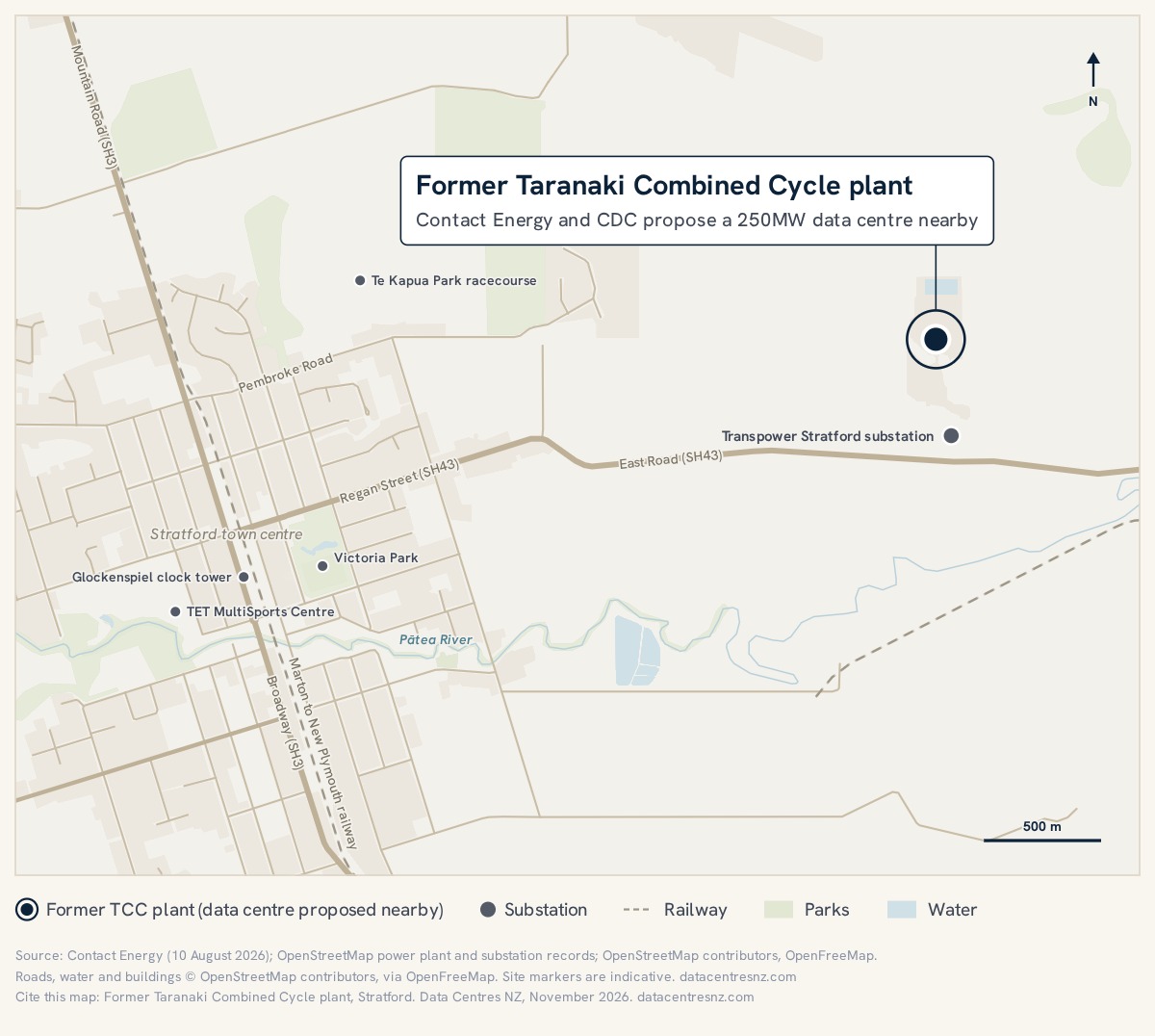
Stratford has an existing grid connection and 500MW of grid-scale batteries already consented, with minor substation works required, the August announcement says. Infratil's results presentation says "Stratford has 350MW transmission capacity available within 1-2 years with minimal substation work".
The data centre would use closed-loop water cooling, the paper reported. High-capacity fibre on land and subsea routes links Stratford to Auckland, where New Zealand's international cables land, according to Contact.
Fuge says the project will more than replace oil and gas in the longer term
Fuge said the project represents a turnaround for Stratford after its gas-fired power station was retired. "Five years ago when I came in, I thought I'd be shutting Stratford down with the decline of gas," he told The Post.
Instead, he believes the development could make Stratford a major energy and technology hub. "In the longer term, I think it will more than replace the oil and gas industry," he said.
The development could create 600 construction jobs, another 400 associated positions and about 200 permanent roles, according to the paper. Fuge said Contact has held community meetings, talked with neighbours and engaged with iwi on the project.
An independent commissioner is assessing the Stratford application
An independent commissioner has been appointed to assess the application. Within two to three weeks, the commissioner is expected to decide whether Contact needs to supply more information, The Post reported.
The proposal needs resource consent for both land use and subdivision, according to Blair Sutherland, the council's director of environmental services. The assessment will cover the full range of environmental effects, he said.
No decision has been made on whether the public can make submissions on the application, a step called public notification, Sutherland said. "Council won't know a timeframe for a decision until after a notification decision is made," he said.
What to watch
More information. The commissioner's call on whether the application needs more detail.
Public submissions. The notification decision. The council says it will not know the timeframe for a consent decision until that is made.
A customer. Whether Contact and CDC sign an anchor tenant, the first large customer whose contract underpins the build.