At a glance
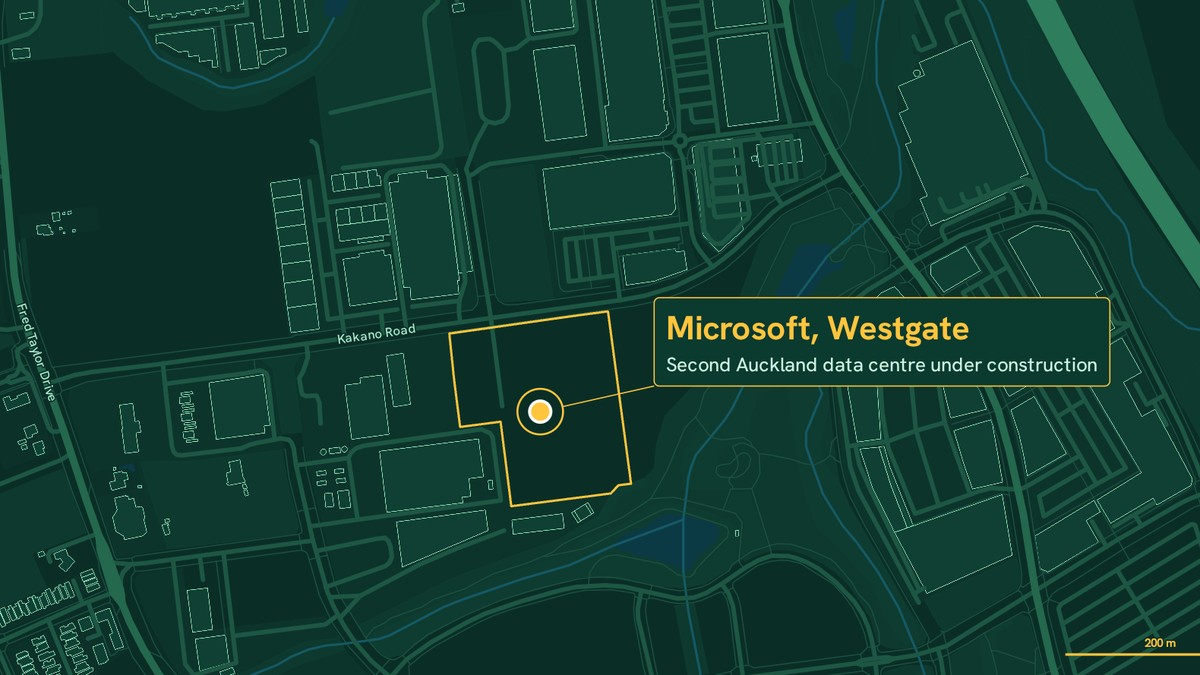
Microsoft has started building a second data centre at Westgate in northwest Auckland, in front of the one that opened in December 2024.
The build began in September and is due for completion in 2028, the NZ Herald reported. Icon Construction is the builder.
Auckland Council issued a building consent on 2 October for a two-storey data centre with eight data halls at the site, with a project value of NZ$290 million.
Microsoft says the expansion will support up to 500 jobs during peak construction and about 40 permanent roles once it opens.
Transpower lists a 20MW Henderson feeder for Microsoft, due on 1 November 2027.
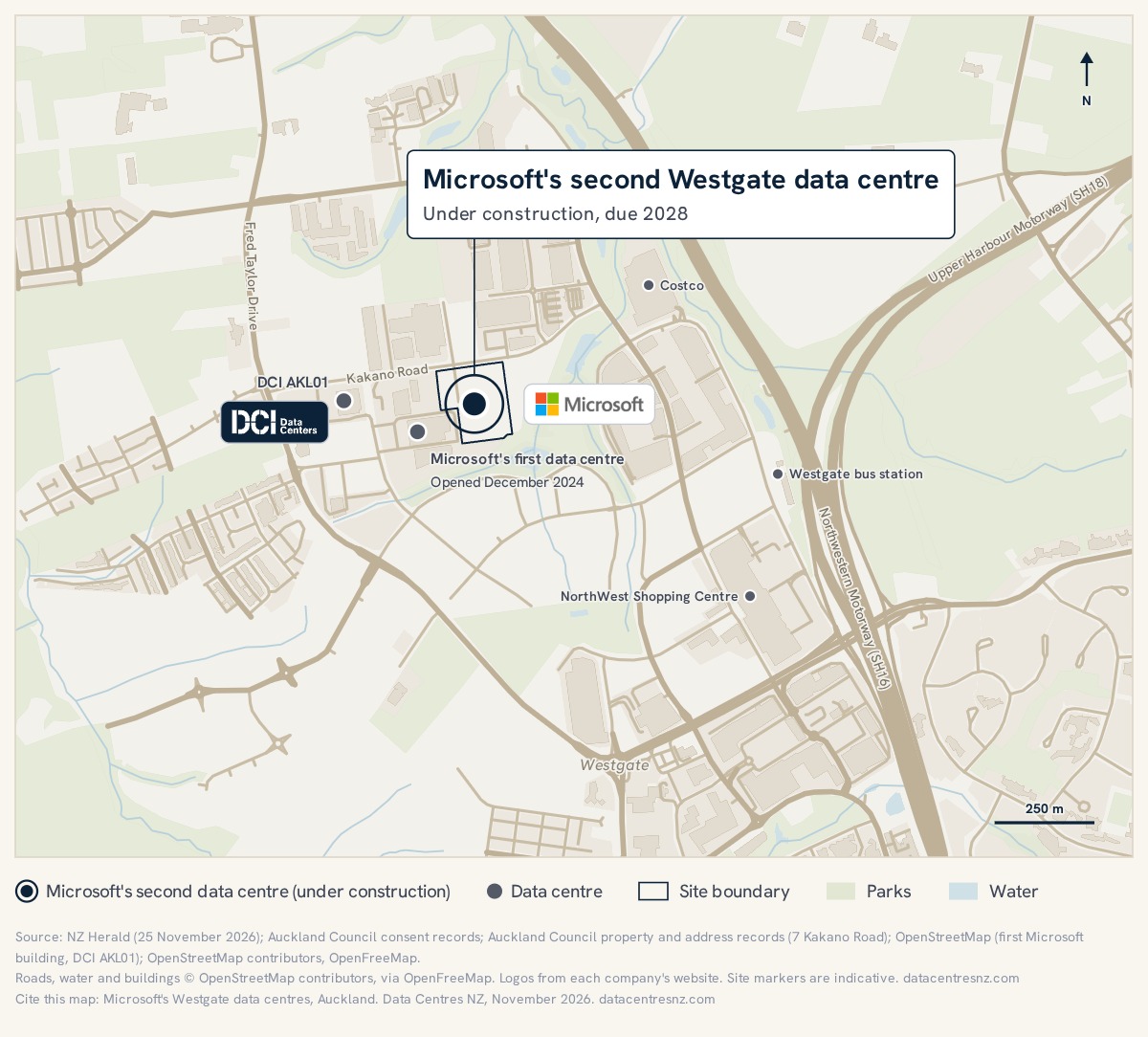
Microsoft has started building a second data centre at Westgate in northwest Auckland. The new building sits at 7 Kakano Road, in front of the data centre that opened its New Zealand North cloud region in December 2024. The NZ Herald reported the build on 25 November.
"Construction has begun on the expansion of our New Zealand North Datacentre Region, which will support up to 500 jobs during peak construction and approximately 40 new permanent roles once operational," a Microsoft spokesman told the paper. He said access to local computing capacity is "vital to the delivery of critical public services and to sustaining New Zealand's economy".
A cloud region is a group of data centres that a cloud provider runs to serve customers in one area. The company opened its region in December 2024 and calls it New Zealand's first hyperscale cloud. Amazon Web Services opened its Auckland region in September 2025.
Auckland Council's consent records put the project value of the two-storey, eight-hall data centre at NZ$290 million.
Microsoft's second building has eight data halls over two storeys
The building consent was issued on 2 October, on the same property as two earlier consents that name Microsoft. It covers a two-storey data centre with an administrative building and four data halls on each level.
The first of those, in August 2025, covered NZ$14.7 million of earthworks for the Microsoft data centre the consent calls AKL03. The second, for a NZ$2.6 million electrical substation, followed in June this year.
Consent documents give the new building a floor area of 10,879.8 square metres, according to the Herald. That is slightly smaller than the first building's 11,600 square metres. The Herald puts the site at 2.8 hectares. Microsoft's own project page dates the start of construction to September 2026.
The second building will run on its own power supply and back-up, separate from the first, the Herald reported. The council's report on the consent lists 13 back-up diesel generators, which the paper read as covering up to 38MW of grid power.
Vector is building a substation for the new data centre
Vector contractors will build a new substation to connect the second building to the grid, the Herald reported, citing the council report. The substation is being paid for by Microsoft, according to a Vector employee who was on site auditing progress.
Power for Westgate comes through Henderson, the grid exit point Vector takes supply from. Transpower updated its list of connection projects on 8 November. It shows a 20MW Henderson feeder for Microsoft, listed as "Henderson 1x 33kV Feeder (Microsoft 1/2)" and due on 1 November 2027.
Vector's 2026 asset management plan expects that kind of demand to keep growing. It says the Westgate commercial area "is rapidly expanding with logistics centres and large datacentres", and that data centres around Westgate and Hobsonville may top "200 MVA in installed capacity". DCI Data Centers already runs its AKL01 data centre further along Kakano Road, and CDC Data Centres runs two Hobsonville campuses nearby.
Amazon also held land at Westgate for a data centre, but stopped work there and wrote down the land's value by NZ$44.9 million, the Herald reported in May. A third Microsoft data centre was once planned about 5km away, at Brigham Creek Road in Whenuapai. The Overseas Investment Office consented that land purchase in February 2023, but the permission has since expired without the company buying the land, according to the Herald. The paper suggests the lapsed project may explain why the two Westgate buildings are named AKL02 and AKL03.
Auckland Council consented the build as light industry
The council granted the project's resource consent without asking the public for submissions. "In this case, the impact of the development was assessed as being no more than minor, which places it below the threshold for public notification," said Dean Williams, the council's manager of premium resource consents.
Public notification is the step where a council invites anyone to make submissions on a consent application. The project predates the changes to the Resource Management Act that took effect on 6 October, the Herald reported.
The council's engineer found the water connection on Kakano Road similar to other industrial sites, with no extreme demand on the public network, the paper reported. "The facility has been designed for New Zealand's unique climate, using air cooling to reduce energy use and eliminate water consumption for cooling," the Microsoft spokesman said. The company also lists a partnership with Community Waitākere on ecological restoration and flood resilience in the Paremuka Stream catchment.
A Contact Energy geothermal deal backs the cloud region
Microsoft says the region is supported by a 10-year agreement with Contact Energy for the renewable attributes of Contact's 51.4MW Te Huka 3 geothermal station, signed in September 2022. "By entering this arrangement with Microsoft, Te Huka Unit 3 got the backing it needed," Contact chief executive Mike Fuge said in a 2023 announcement.
What to watch
The Henderson feeder. Transpower lists the 20MW Microsoft feeder for 1 November 2027. We expect the feeder to be in service before the second building opens, because that date falls ahead of the 2028 completion the Herald reported.
The government's principles. Prime Minister Christopher Luxon ordered principles for large data centres in July. He described them as a compact setting out "the deal by which you come into New Zealand if you want to build out a data centre". He asked Economic Growth Minister Nicola Willis and the Department of the Prime Minister and Cabinet to draft them.