
At a glance
New Zealand's operating colocation fleet is about 208MW across 36 facilities on market researcher Arizton's June count, and two disclosed projects alone would add 530MW on top.
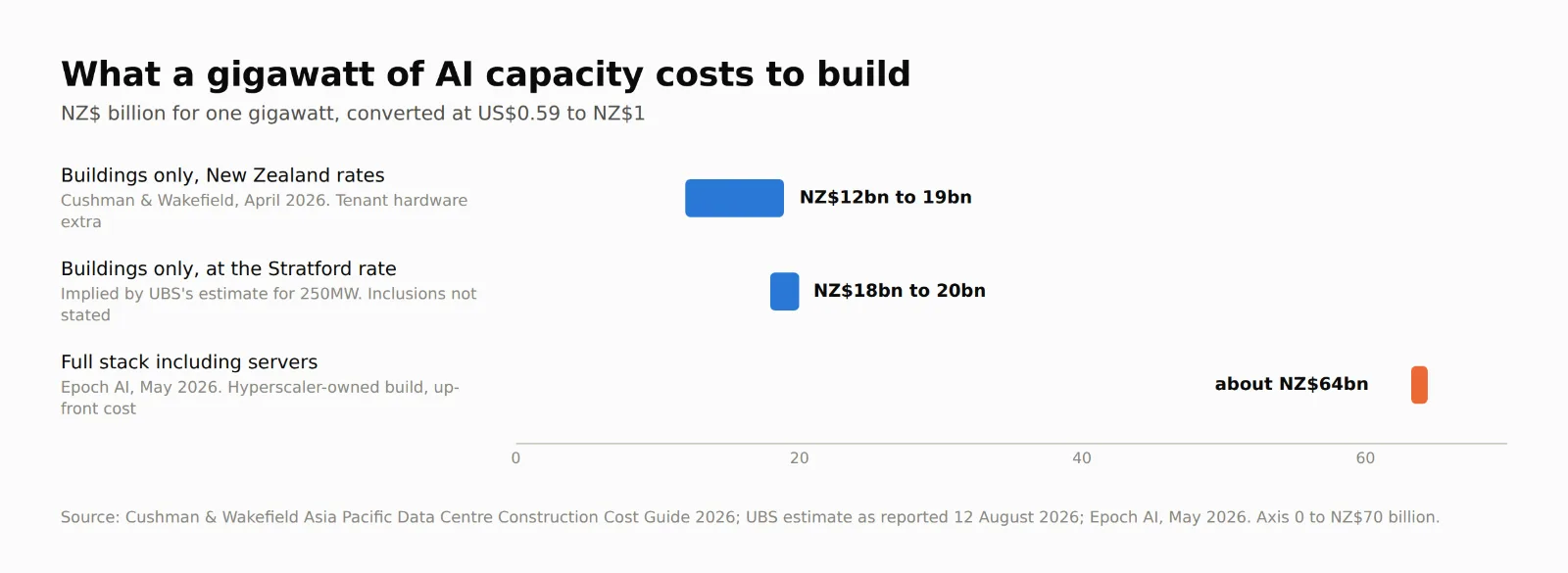
Building a gigawatt of data centre capacity here would cost about NZ$12 billion to NZ$19 billion before any computing hardware, converted from property consultancy Cushman & Wakefield's April benchmark.
Data centres take about 0.6 per cent of national electricity today and are forecast to reach about 3 per cent by 2030 on Energy Minister Simeon Brown's figures, drawn from a grid that ran 85.5 per cent renewable in 2024.
The New Zealand Gigawatt Decade, this publication's first national AI infrastructure outlook to 2030, publishes in mid-September and measures what each megawatt-hour produces, user by user.
Consultancy BCG models New Zealand's opportunity as an export industry of 300MW by 2035, and data centre developer Datagrid has contracted the South Island's first international subsea cable, with service targeted for 2029.
New Zealand's gigawatt decade begins with 530MW on the table
New Zealand has built about 208MW of data centre capacity, spread across 36 colocation facilities that rent space and power to multiple customers, on market researcher Arizton's June count. Two projects now on the table would add 530MW on top of it. The data centre developer Datagrid holds consent for a Southland campus designed at 280MW for its first stage, and its founder has described an expansion pathway toward 1,000MW. Contact Energy and CDC Data Centres are preparing to seek consent for 250MW at Stratford. Behind them, the electricity market regulator, the Electricity Authority, has logged 12 further prospective projects with details confidential, and the working expectation among the operators and investors who met at the Data Centre Leaders Summit in Auckland on 12 August was five to ten AI facilities of more than 100MW each by 2030.
The consultancy BCG's February study models New Zealand's opportunity as an export industry, adding 300MW of export-oriented capacity by 2035 on top of domestic growth. Datagrid has contracted the first international subsea cable to land in the South Island, 2,300km to Melbourne with service targeted for 2029. Its founder and chief executive, Rémi Galasso, told this publication this month: "What used to be seen as New Zealand's disadvantage, our distance, our remoteness, is now clearly an advantage."
Prime Minister Christopher Luxon directed officials in July to draft data centre investment principles. The investment attraction agency Invest New Zealand has named Makarewa, Twizel, Ōhau, Geraldine and Cromwell as advantaged data centre zones. About 30 protesters stood outside the Auckland summit the same day the industry met inside. New Zealand votes on 7 November, and the principles are still being drafted.
Energy Minister Simeon Brown puts data centres at about 0.6 per cent of national electricity today and about 3 per cent by 2030, and both figures count consumption. No published New Zealand study we could locate measures what a megawatt-hour produces in the hands of the user who takes it, so New Zealand is choosing how to commit contested electricity for a generation on consumption figures alone.
The NZ AI Infrastructure Index puts a gigawatt of new capacity at NZ$12 billion to NZ$19 billion of construction before a single server is racked, on a grid that ran 85.5 per cent renewable in 2024, in an economy the World Bank put at about NZ$450 billion in 2025. That figure converts property consultancy Cushman & Wakefield's April benchmark at about US$0.59 to the New Zealand dollar, and it is a working number behind The New Zealand Gigawatt Decade, the outlook this publication's NZ AI Infrastructure Index will release in mid-September. The outlook will carry what the build costs, what it draws from the grid, what each megawatt-hour returns by user, and where the national pipeline stands against six public gates.
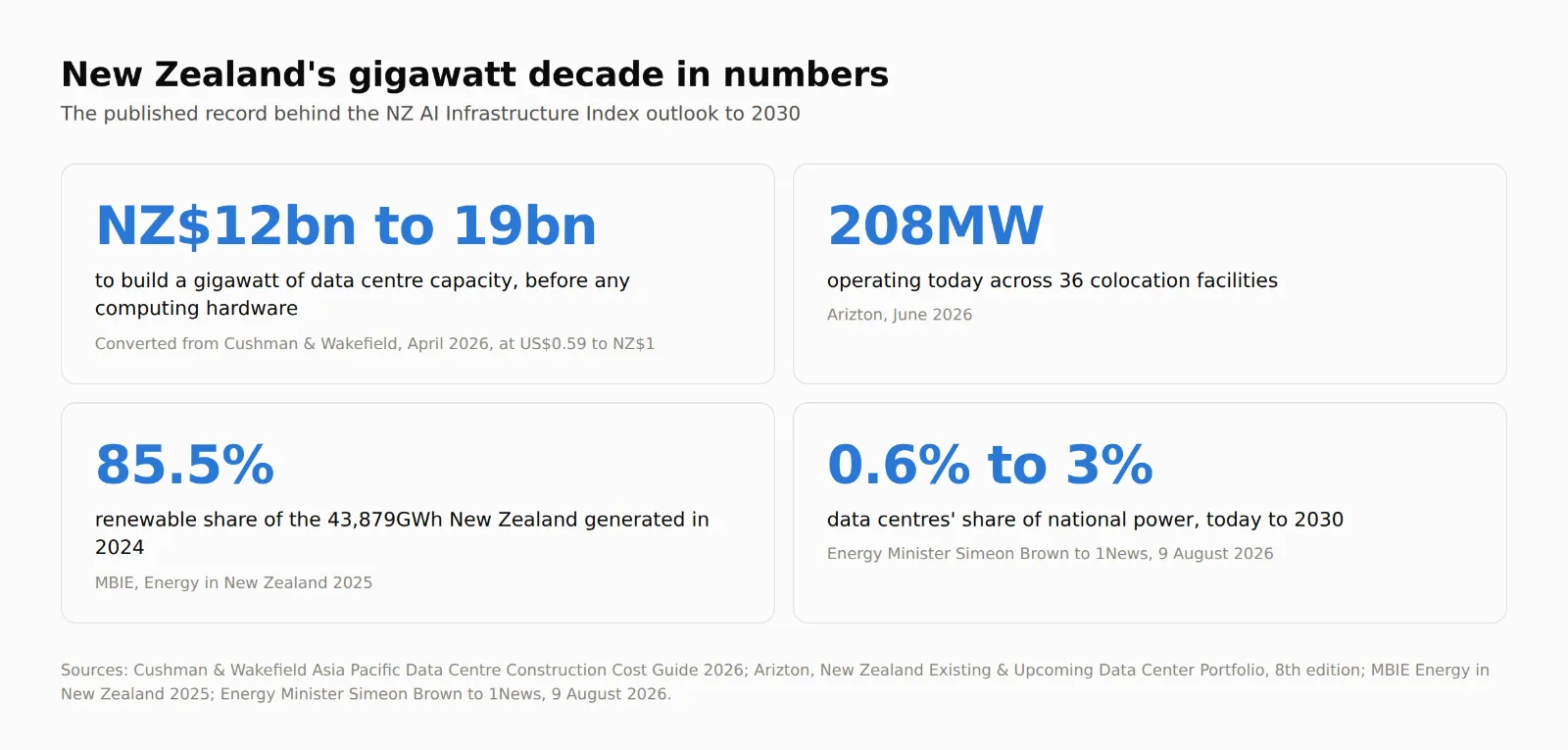
An 85.5 per cent renewable grid generated 43,879GWh in 2024
New Zealand generated 43,879GWh of electricity in 2024, 85.5 per cent of it renewable, and national demand ran to 40,002GWh, on Energy in New Zealand 2025 from the Ministry of Business, Innovation and Employment (MBIE). "NZAS is the single largest user of electricity in the country, accounting for around 12% of the national annual electricity consumption on average over the past decade," MBIE writes of New Zealand Aluminium Smelters, the Rio Tinto majority-owned operator of the Tiwai Point smelter. NZAS contracted 572MW with Meridian, Contact and Mercury in 2024, running to at least 2044, with demand-response agreements that let the system call back up to 185MW when supply runs short.
Sector | 2024 consumption | Share of demand |
|---|---|---|
Residential | 14,008GWh | 35% |
Industrial | 12,480GWh | 31% |
Commercial | 9,356GWh | 23% |
Agriculture | 2,746GWh | 7% |
Other | 1,411GWh | 4% |
Source: MBIE, Energy in New Zealand 2025. Shares of 40,002GWh of national demand, rounded.
Data centres sit inside those industrial and commercial totals at about 0.6 per cent of national power on the minister's figure. Arizton's 208MW is colocation capacity as built and the minister's share is electricity consumed, so the two are not the same measure. The Electricity Authority estimates the 280MW first phase at Makarewa alone would draw about 1.7TWh a year, 4.25 per cent of national consumption, and the two figures do not net out: the authority sizes one project's annual draw against today's consumption, on a timetable that depends on when Makarewa reaches full load and how fast national demand grows. Brown told 1News he wants "AI data centres underwriting new generation and growing generation in New Zealand", that they are "going to need firming as well", firming being backup supply for the hours renewables run short, and that he does not want them "pushing up the power bills of ordinary Kiwis".
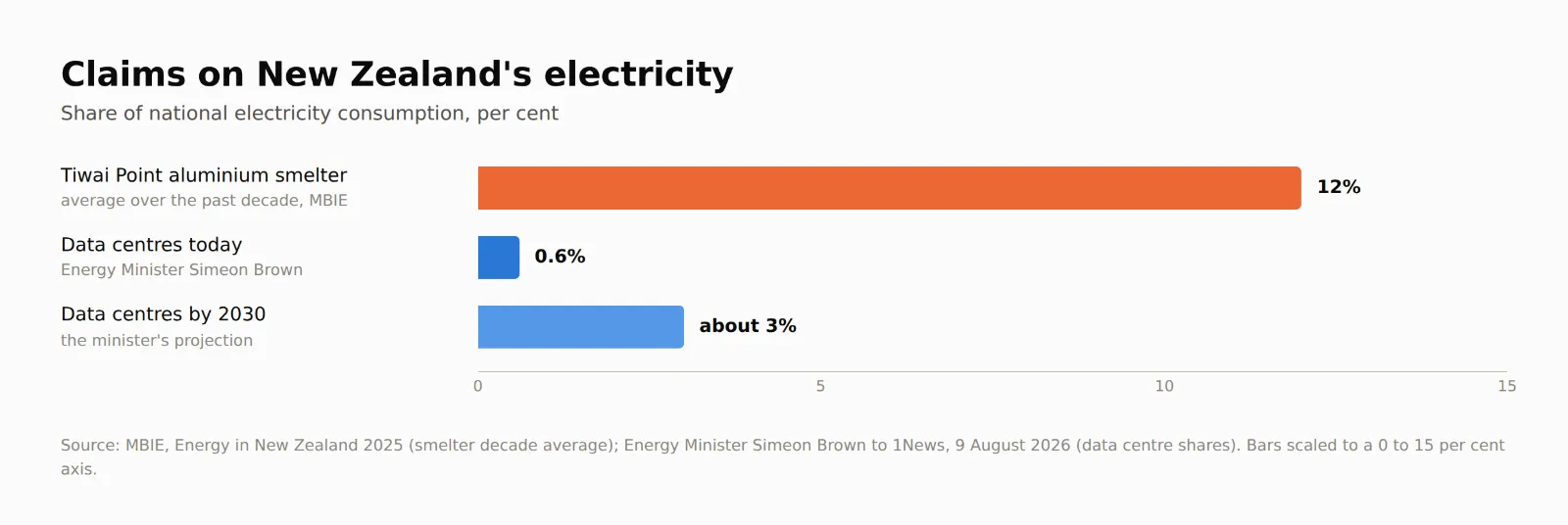
Rio Tinto puts numbers on what the smelter's power produces
Rio Tinto's disclosures show what sits behind the largest existing claim on the grid: about 1,000 full-time-equivalent employees and contractors at Tiwai Point, a further 2,200 people employed indirectly, and about NZ$400 million contributed to the Southland economy each year, which the company puts at 6.5 per cent of the region's GDP. The New Zealand Gigawatt Decade will measure data centres against that same 572MW.
Datagrid discloses 1,200-plus construction jobs and 50 to 80 permanent roles for its 280MW first phase. GPU cloud company Sharon AI holds the largest AI cloud contract disclosed in New Zealand, US$1.32 billion over five years. BCG's February study, Data centres as strategic infrastructure, puts up to NZ$70 billion of economic activity over the next decade from a 600MW build under its export base case to 2035. The outlook will report value added, the same basis the national accounts use, convert capacity to electricity consumed, separate direct output from enabled activity, and publish its sensitivities.
Brookfield prices new builds at low-to-high-teens returns
Established data centres with contracted income return 6 to 7 per cent, and new developments low to high teens, Sean Robertson, managing director for debt investments at Brookfield Asset Management, told the summit's investment panel. Cushman & Wakefield's April Asia Pacific Data Centre Construction Cost Guide brackets New Zealand at US$7.3 million to US$11.2 million a megawatt, facility only, and describes ANZ construction as mid-pack in the region.
Benchmark | Figure | Scope |
|---|---|---|
Cushman & Wakefield, April 2026 | US$7.3m to US$11.2m a megawatt | Facility construction only, tenant hardware extra |
UBS, Stratford estimate | NZ$4.5 billion to NZ$5 billion for 250MW | Inclusions not stated by UBS |
Epoch AI, May 2026 | About US$38 billion for one gigawatt | Hyperscaler-owned AI data centre, up-front cost including servers |
Source: Cushman & Wakefield Asia Pacific Data Centre Construction Cost Guide 2026, UBS as reported 12 August 2026, Epoch AI.
Investment bank UBS's Stratford estimate implies about NZ$18 million to NZ$20 million a megawatt, spanning the top of the converted Cushman & Wakefield range and extending above it, with UBS not stating what its figure includes. The AI research group Epoch AI puts a one-gigawatt hyperscaler build at about US$38 billion up front, which covers the servers as well as the buildings. Datagrid has pre-paid Transpower in full for four transformers for its 360MVA Makarewa substation, headroom above the 280MW first stage, targeted for commissioning in late 2027, with trade sources pricing such units above US$10 million each. Mercury holds a 15-year option over 140MW of Datagrid's supply and paid US$30 million for 12.7 per cent of the company. Contact says it is prepared to take up to half the equity in the Stratford development. Datagrid founder and chief executive Rémi Galasso locates the workforce constraint in specialist technicians and engineers and says construction capability is already in the country.
The New Zealand Gigawatt Decade lands in September
The New Zealand Gigawatt Decade projects the country's AI build to 2030, costing the capacity, sizing the electricity it will draw, and measuring what each megawatt-hour returns to the country that supplies it. It prices a gigawatt against an economy of NZ$450 billion, sizes the export opportunity BCG models against built capacity, and counts the jobs and value added each megawatt carries.
The outlook anchors a standing programme. The Index will publish it every year and special reports between editions as projects clear their gates and new capacity is announced, so operators, investors and officials have one place to check what New Zealand has built and what is coming.
The New Zealand Gigawatt Decade will also carry a running count of the national pipeline against six gates drawn from the public record: resource consent granted, grid connection contracted, power supply contracted, capital committed, customers contracted, and long-lead equipment ordered. Each gate carries a megawatt total, giving the market a capacity figure at every stage of the build.
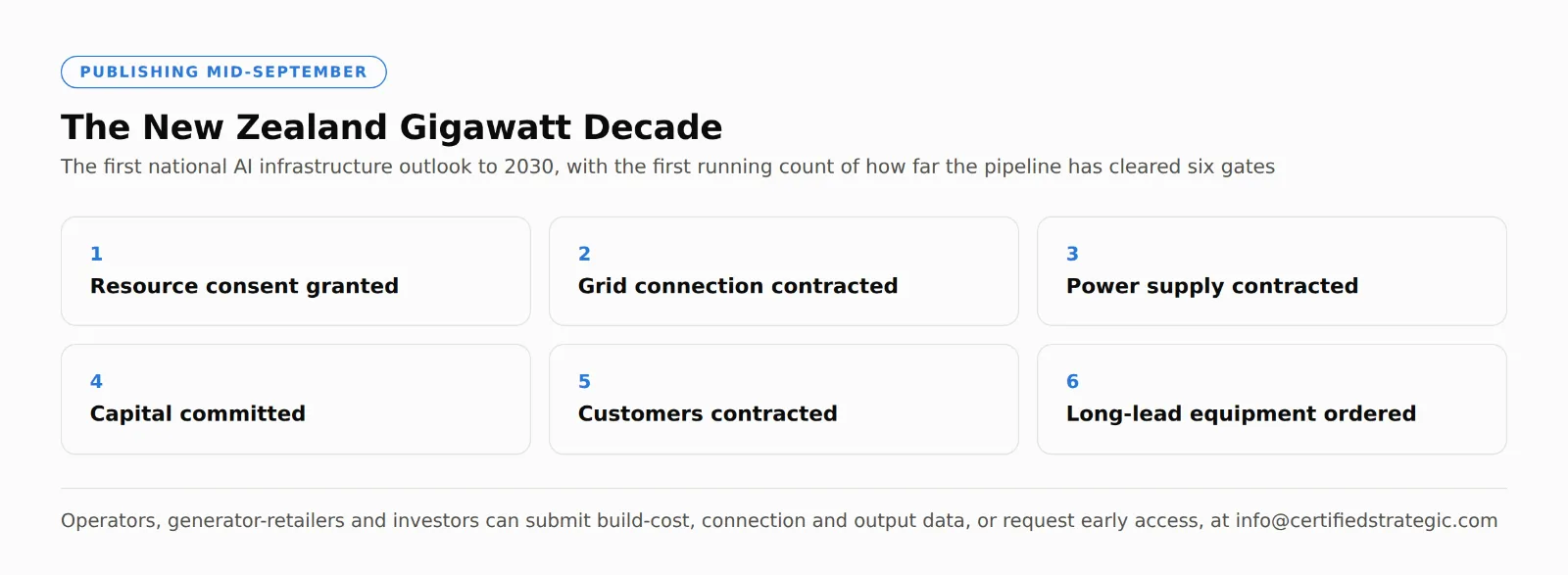
What to watch
The Willis principles. Economic Growth Minister Nicola Willis and the Department of the Prime Minister and Cabinet are drafting data centre investment principles on Luxon's 27 July direction, with additionality, new generation to match new load, scaled to project size.
The 7 November election. The Greens are campaigning on a one-year consenting pause for new AI data centres; ACT has said it would not back one.
The Makarewa substation. Transpower targets late 2027 commissioning for the 360MVA connection, with Datagrid's transformers already paid for and earthworks due to start within a month, by Galasso's account.
The New Zealand Gigawatt Decade. The outlook publishes in mid-September, carrying the measurement of economic output per megawatt-hour and the first count of how far the pipeline has cleared its six gates. Operators, generator-retailers and investors can submit build-cost, connection and output data, or request early access, at info@certifiedstrategic.com.