At a glance
Turner & Townsend published its tenth annual data centre construction cost index on 22 October 2026, covering 62 cities and more than 500 projects.
Auckland costs US$12.69 a watt to build, the highest of the three Australian and New Zealand cities and 17th in the world.
Auckland ranked 8th last year and 6th in 2024, because building costs rose faster in Europe and North America.
In the firm's survey of 400 industry experts, 56 per cent named access to power as a major obstacle to building data centres.
At the Auckland rate, the building is about a quarter of the US$50 billion NVIDIA's Jensen Huang puts on a complete 1GW AI data centre.
Turner & Townsend, the construction consultancy majority-owned by property group CBRE, published its annual data centre construction cost index on 22 October 2026. Now in its tenth year, the index tracks what it costs to build a data centre in a given city. This edition prices 62 cities, draws on more than 500 live or recent projects and surveys 400 people who build data centres.
Auckland is the only New Zealand city in the index. Certified Strategic, this publication's Australian edition, compared Sydney and Melbourne with the rest of Asia-Pacific on the same figures. Auckland is the dearest place in Australia and New Zealand to build a data centre, but it has fallen from 8th to 17th in the world in a year as costs elsewhere rose faster.
Auckland costs US$12.69 a watt to build
The index quotes the cost of building a typical 60MW data centre in US dollars for each watt of capacity. Auckland comes in at US$12.69 a watt, against US$10.74 for Sydney and US$10.58 for Melbourne. That makes Auckland about 18 per cent dearer than Sydney. Applied to a 100MW data centre, the Auckland rate puts the building at about US$1.27 billion.
That figure covers the building, its electrical and cooling plant, and the builder's costs and margin. Land, the grid connection and the computers that go inside are extra.
Auckland ranks 17th of 62 cities, two places below London at US$12.95. Amsterdam at US$12.64, Dublin at US$12.60 and Frankfurt at US$12.49 follow just behind it.
Costs rose faster in Europe and North America
Auckland's cost rose about 3 per cent in US dollars, from US$12.30 a watt in the 2025 index. Average costs rose 13 per cent in North America and Europe, twice the global average of 6 per cent, according to Turner & Townsend.
Dublin rose about 25 per cent and Amsterdam about 17 per cent, which took both close to Auckland. Auckland ranked 8th last year and 6th in 2024, when the index put it at US$12.00 a watt. It was already the most expensive of Australia and New Zealand's major markets in 2025, Build Australia reported.
Turner & Townsend now benchmarks a bigger building, 60MW against 30MW to 50MW last year, so the change between editions is approximate. It converts every city at the average exchange rate between 1 October 2025 and 1 October 2026.
Fifty-six per cent of survey respondents name power as a major obstacle
Turner & Townsend calls access to power "the defining challenge" facing data centre development. Fifty-six per cent of respondents named access to power as a major obstacle to delivering a project. Fifty-three per cent said a grid connection takes one to two years, and another 32 per cent said longer. The share using or exploring alternative power sources has tripled since the 2025 survey, to 42 per cent.
In New Zealand, Transpower was assessing about a gigawatt of data centre connection enquiries in August. Datagrid began construction at its 280MW Makarewa campus in August, and Contact Energy and CDC plan a 250MW data centre at Stratford beside an existing grid connection.
In Auckland itself, NEXTDC has withdrawn its consent application for a 15MW data centre in the central city, BusinessDesk reported on 21 October. Data Vault plans a 3MW site on the North Shore, with its first stage due in the second half of 2027.
Eighty-one per cent of respondents described skilled labour in their region as constrained, with mechanical, electrical and plumbing trades the most sought after.
Chips make up most of an AI data centre's cost
Huang told NVIDIA's GTC Berlin conference on 21 October 2026 that a complete 1GW AI data centre costs about US$50 billion, counting the land, power, building, chips and networking. Applied to a gigawatt, Turner & Townsend's Auckland rate gives about US$12.7 billion for the building, about a quarter of Huang's figure.
Other estimates for New Zealand use different measures. UBS, the investment bank, has put the 250MW Stratford build at NZ$4.5 billion to NZ$5 billion, as this publication reported. Cushman & Wakefield's April guide prices New Zealand construction at US$7.3 million to US$11.2 million a megawatt, facility only, as reported in the cost of New Zealand's data centre decade. The firms measure different scopes, so their figures are not directly comparable with the index.
Tokyo tops Asia-Pacific at US$18.28 a watt
The index prices 17 cities in Asia-Pacific, and the chart below shows all of them.
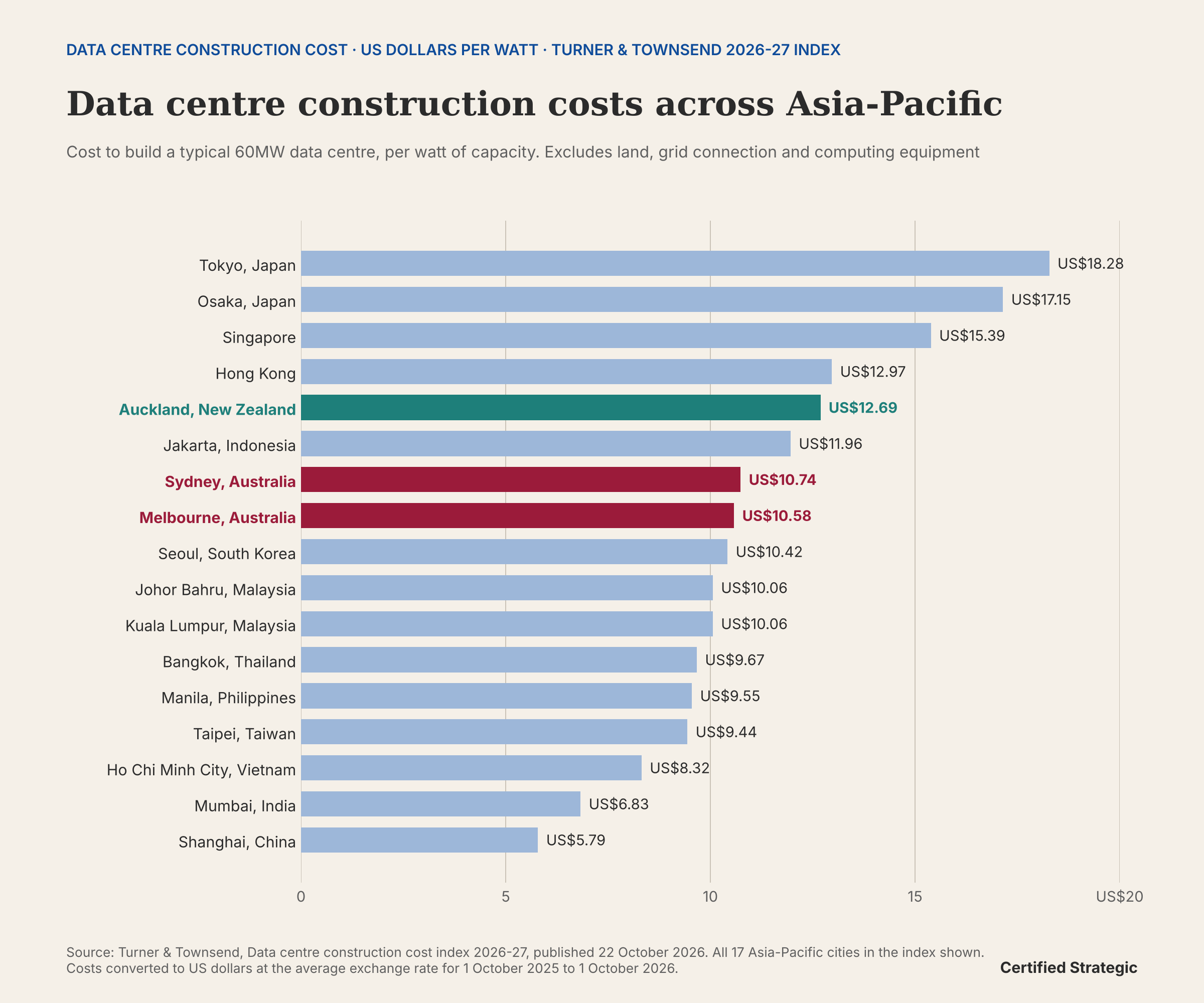
Tokyo is the dearest city in the whole index for a fourth year, at US$18.28 a watt, with Osaka next at US$17.15. Singapore is US$15.39 and Hong Kong US$12.97. Building in Auckland costs about 18 per cent less than in Singapore, and Auckland ranks fifth in the region behind those four.
Hong Kong is one of 12 cities added to the index this year. It is the only new entry above Auckland.
Paul Newfield, chief executive of infrastructure investor Morrison, whose assets include Infratil, told an Auckland conference on 13 October that New Zealand should be winning AI work leaving the United States.
This publication's read is that Auckland remains dear to build in, but its costs are rising more slowly than in the markets New Zealand competes with for data centre capital.
What to watch
Stratford's consent. Contact and CDC plan to seek resource consent for the 250MW project, one of New Zealand's largest planned builds.
The exchange rate. The index converts local costs to US dollars, so a stronger New Zealand dollar would lift Auckland's figure.
The next index. Turner & Townsend's 2027-28 edition will show whether Auckland's slower rise holds.
Cushman & Wakefield's 2027 guide. It is the second benchmark for New Zealand construction costs. The full pipeline is in New Zealand's data centre power list 2026 and the gigawatt decade.